
19 min read ·
Why an “Indica” Label Can’t Tell You How Tired You’ll Feel
Some people stay alert or feel anxious instead. Even sedation or faster sleep onset can coexist with awakenings, poor-quality sleep or next-day grogginess.
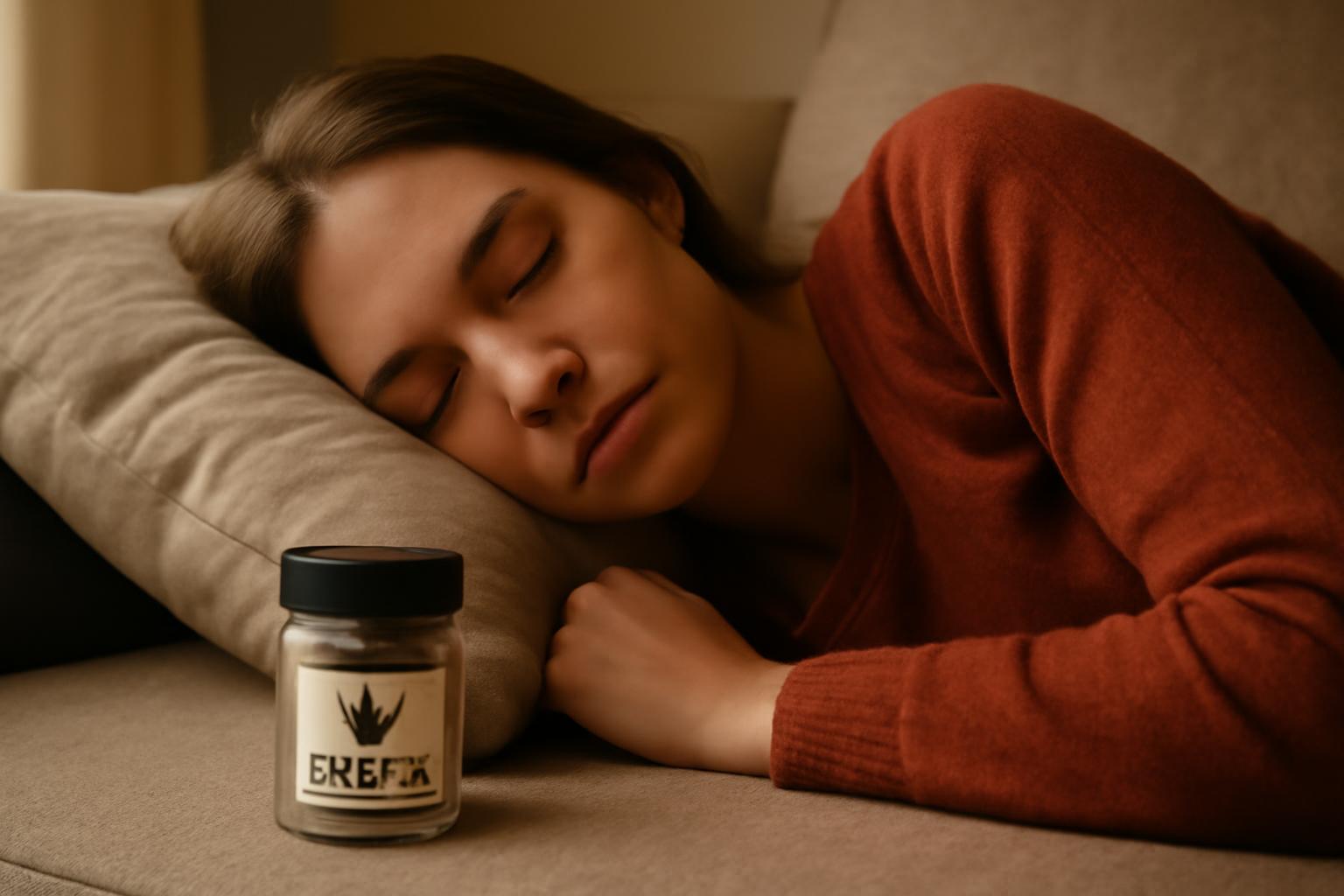
The short answer: indica can make you sleepy, but not reliably
Yes, an indica-labeled cannabis product can make some people feel calm, physically heavy, drowsy, or ready to sleep. But that response is not guaranteed. Another person—or the same person on another occasion—may feel relaxed without becoming sleepy, remain alert, or experience anxiety or stimulation.
The most accurate answer to “does indica make u sleepy?” is that sleepiness is one possible effect, not a dependable property of the label. Products sold as indica vary in chemical composition, strength, formulation, and effects. Individual responses vary too. Consumer health guidance therefore treats indica’s association with relaxation as a broad tendency rather than a reliable prediction for a particular product or person (WebMD’s overview of indica and sativa).
It helps to separate four outcomes that are often treated as interchangeable:
- Relaxation: Feeling calmer, less tense, or physically at ease.
- Subjective drowsiness: Feeling heavy-eyed, slowed down, or inclined to lie down.
- Falling asleep sooner: Spending less perceived time awake after going to bed.
- Obtaining better-quality sleep: Sleeping in a way that supports alertness and functioning the next day.
A product could produce relaxation and drowsiness without reliably shortening the time it takes to fall asleep. It could also make someone fall asleep sooner without reducing awakenings or preventing next-day grogginess. Sedation describes an experience while a substance is active; restorative sleep is a broader physiological and functional outcome.
Most clinical sleep research does not compare commercial indica products with chemically matched sativa products. Researchers more often examine cannabis generally, THC, CBD, prescription cannabinoids, or mixed cannabinoid formulations. Those findings cannot establish that the commercial word indica represents a distinct sleep-inducing effect.
Bottom line
- Possible sleepiness: Yes
- Guaranteed by the indica label: No
- Proven treatment for insomnia: No
If someone feels tired after using an indica-labeled product, the experience is real. What cannot be concluded is that every indica will have the same effect, that the category itself caused the response, or that the resulting sleep is healthier.
Why indica and sativa labels are weak predictors
Indica has traditionally been associated with physical relaxation, heavier effects, and nighttime use. Sativa has traditionally been associated with alertness or daytime use. These associations remain common in product descriptions and everyday conversation, but they are not clinical guarantees.
Extensive breeding and hybridization have blurred the distinction. Products within the same category can contain different amounts of THC and CBD, different mixtures of other cannabinoids and terpenes, and different formulations. Even individual plants within a category can produce different effects, which is why consumer health guidance recommends considering chemical composition rather than relying only on an indica, sativa, or hybrid label (Healthline’s explanation of cannabis type labels).
In practice, indica often functions as a market descriptor. It may indicate that a product is positioned as relaxing, body-focused, or suitable for evening use. It does not disclose exactly what is in the product or predict how a particular person will react.
The same limitation applies to strain or cultivar names. Turning flower into an extract, beverage, or edible introduces additional variables. Nighttime branding does not remove that uncertainty.
Individual response adds another layer of unpredictability. Two people can use the same product and report different experiences. Prior exposure, tolerance, mood, expectations, food, other substances, and surroundings may all influence what happens. A person’s response may also change over time.
| Myth | What the evidence supports |
|---|---|
| “Indica always causes sleep.” | Some indica-labeled products feel sedating to some people. Others cause relaxation without sleepiness or may produce alertness, anxiety, or other effects. |
| “Sativa always provides energy.” | Sativa is commonly marketed as uplifting, but the category does not guarantee stimulation or prevent drowsiness. |
| “Hybrid means a predictable middle effect.” | Hybrid is a broad category, not a standardized balance of relaxing and stimulating effects. |
| “A familiar strain name guarantees a familiar result.” | Products sharing a name may differ by producer, batch, formulation, growing conditions, and measured cannabinoid content. |
These labels are not entirely meaningless. They can summarize tradition, plant ancestry, marketing intent, or commonly reported experiences. The problem arises when a rough descriptor is treated like a measured dose or a clinical effect category.
A better mental model is:
- Indica, sativa, and hybrid are broad clues.
- Measured composition and formulation provide more concrete information.
- Neither can perfectly predict an individual response.
Named strains are therefore not recommended here as sleep solutions. A product name, botanical category, or moon-and-stars package design does not demonstrate sedation, better sleep, or effective insomnia treatment.
What may matter more than the word “indica”
Several variables are more useful than the category label when trying to understand why a product felt sedating—or why it did not.
Product composition
THC content: THC is intoxicating. It can cause drowsiness, but it may also cause anxiety, confusion, dizziness, impaired attention, paranoia, memory problems, or poor coordination. More THC should not be interpreted as automatically better for sleep.
CBD content: CBD does not produce the same characteristic high as THC, but it still affects the body and can cause side effects. It may also interact with medications. No particular amount or THC-to-CBD ratio has been established as a universal sleep formula.
Other chemical characteristics: Terpenes and less-studied cannabinoids may contribute to differences between products, but their effects cannot yet be predicted with the precision often implied by marketing.
Two packages can both say indica while containing substantially different THC and CBD levels. They may also contain different extracts, carrier ingredients, or cannabinoid mixtures. Those differences can matter more than the category printed on the front.
Amount used
The amount consumed can alter both the intensity and character of the experience. An amount associated with relaxation on one occasion could be associated with dizziness, anxiety, confusion, or excessive sedation on another. Taking more is not a reliable or appropriate way to produce better sleep.
The relevant amount is not necessarily “one gummy,” “one inhale,” or “one serving.” Products differ in concentration, and a package serving may not correspond to someone’s previous experience. The measurable cannabinoid content matters more than the unit’s name.
Product formulation and administration route
Flower, concentrates, vaporized products, oils, beverages, capsules, and solid edibles do not behave identically. Route affects how quickly effects become noticeable, how easily they can be judged in real time, and how long they may persist.
Formulation also matters within a route. Two edibles with the same front-label category may differ in cannabinoid content, serving size, and ingredients. An inhaled product and an edible made from the same named cultivar should not be expected to feel interchangeable.
Tolerance and prior experience
That can complicate attempts to decide whether cannabis is still helping with sleep.
Past personal response may provide useful context. If a documented product repeatedly caused grogginess, that pattern is more specific than its broad market category. It is still not a guarantee: batches, health status, context, other substances, and tolerance can change.
Timing, mood, surroundings, and other substances
A person who is already tired late at night may interpret relaxation as strong sedation. The same product used earlier, during stress, or in unfamiliar surroundings may feel different. Expectations may also shape how sensations are noticed and described.
Food, alcohol, medications, and other substances can alter the experience. Health Canada notes that response can vary with THC and CBD content, amount, previous experience, consumption method, food, alcohol, medications, and other substances (Health Canada’s guidance for adults over 55).
Individual biology
Age, metabolism, sensitivity to THC, underlying health conditions, and other biological differences can influence both subjective effects and impairment. There is no single response shared by everyone who uses a product carrying the same label.
A measurable label-reading checklist
For someone who already chooses to use cannabis, the most useful package details are the measurable ones:
- THC per serving and per package
- CBD per serving and per package
- The manufacturer’s defined serving size
- Product type and route, such as inhaled flower, oil, beverage, or solid edible
- Available laboratory information, including cannabinoid results and other testing disclosed through the regulated market
Treat indica, night, rest, calm, and similar words as descriptions—not measurements.
A neutral observation template
Someone who already uses cannabis may choose to record their experiences. This is not a validated medical protocol and cannot establish whether cannabis treats a sleep disorder. It can simply make patterns easier to notice.
| Item | What to record |
|---|---|
| Product | Exact product and batch information, if available |
| Labeled composition | THC and CBD per serving; available laboratory details |
| Amount | The amount actually consumed, not merely the package serving |
| Time | When it was used |
| Route | Inhaled, edible, oil, beverage, or another format |
| Immediate effects | Relaxation, drowsiness, alertness, anxiety, dizziness, confusion, or no clear effect |
| Perceived sleep quality | Better, worse, unchanged, or uncertain |
| Awakenings | Whether sleep seemed more or less interrupted |
| Next-day alertness | Clear, mildly groggy, substantially impaired, or uncertain |
The purpose is observation, not dose escalation. Worsening sleep, increasing use, daytime impairment, or a growing sense that sleep is impossible without cannabis should prompt a discussion with a qualified healthcare professional.
THC, CBD, and terpenes: what the evidence can—and cannot—say
Cannabis chemistry provides more useful information than a broad category label, but it still cannot forecast an individual response perfectly.
THC
THC is the principal intoxicating cannabinoid. Drowsiness is one possible effect, but it is not the only one. Depending on the person, amount, product, and circumstances, THC can also cause anxiety, confusion, dizziness, paranoia, memory or attention problems, and impaired coordination. Health Canada lists drowsiness alongside anxiety, confusion, poor coordination, and attention or memory impairment among possible THC-related effects (Health Canada’s summary of cannabis effects).
A stronger intoxicating effect should not be equated with a stronger therapeutic sleep effect. Feeling heavily impaired may make remaining awake difficult, but it does not demonstrate more restorative sleep or better next-day functioning.
CBD
CBD is commonly described as non-intoxicating because it does not produce the same characteristic high as THC. Non-intoxicating does not mean inactive or risk-free. CBD can have effects and side effects, and medication compatibility should not be assumed.
Its relationship with sleep may vary with the formulation, amount, population, and presence of other cannabinoids. The available evidence does not justify declaring one THC-to-CBD ratio a universal sleep formula.
Myrcene and other terpenes
Myrcene is an aromatic compound frequently associated in cannabis coverage with earthy-smelling products, relaxation, and sedation. That association is often offered as an explanation for why some indica-labeled products feel physically heavy or sleepy.
A proposed explanation is not the same as a demonstrated clinical rule. Evidence involving isolated compounds, laboratory studies, animals, or user reports cannot by itself establish predictable sedation in people using whole cannabis products. Physician-reviewed commercial coverage acknowledges both the proposed role of myrcene and the substantial variation created by cannabinoid mixtures and individual response (discussion of myrcene and indica effects).
No adequately established myrcene percentage guarantees sedation, “couch-lock,” or faster sleep onset. The same caution applies to linalool, terpinolene, limonene, pinene, and other terpenes. They may contribute to aroma and possibly to a product’s overall effects, but they should not be treated as individual sleep switches.
What about CBN?
CBN is another cannabinoid often marketed in nighttime products. Its proposed sedative role remains uncertain. Evidence is not strong enough to conclude that CBN reliably induces sleep by itself or that a THC-CBD-CBN combination is a proven treatment for insomnia.
| Established possibilities | Plausible but uncertain explanations | Unsupported guarantees |
|---|---|---|
| THC can cause intoxication, drowsiness, and impairment. | Overall cannabinoid and terpene mixtures may help explain why products feel different. | A particular myrcene percentage always causes sedation. |
| THC can also cause anxiety, dizziness, confusion, or poor coordination. | Myrcene may contribute to the sedating experience reported with some products. | CBN reliably induces sleep. |
| CBD is non-intoxicating but can still have effects and side effects. | Individual biology may change how a chemical profile is experienced. | One THC-to-CBD ratio works for everyone. |
| Products carrying the same indica label can differ in composition. | Interactions among cannabinoids and terpenes may matter. | An indica label proves that a product has a sedating chemical profile. |
| Subjective sedation does not establish better sleep quality. | Evidence for specific formulations and selected populations remains insufficient. | A THC-CBD-CBN blend is a clinically proven insomnia treatment. |
The practical lesson is not that chemistry can be ignored. It is that measured chemistry supplies better clues than a category label while still leaving substantial uncertainty.
Edibles versus inhaled cannabis: onset, duration, and next-day grogginess
The way cannabis is consumed can change when effects appear, how long they persist, and how easily someone can misjudge an amount.
Inhaled cannabis generally takes effect faster. That faster feedback may make a developing effect easier to recognize, although inhalation is neither predictable nor free of health and impairment risks.
Edible cannabis generally begins more slowly and tends to last longer. Because the initial effect may not be obvious right away, someone may assume the first amount did nothing and consume more. The combined effect can then become stronger or more prolonged than intended. Commercial product education describes this relative difference while also emphasizing that exact timing varies by product and person (comparison of inhaled and edible products).
| Feature | Inhaled cannabis | Edible cannabis |
|---|---|---|
| Relative onset | Generally faster | Generally slower |
| Relative duration | Generally shorter | Generally longer |
| Delayed-overconsumption risk | Overconsumption remains possible, but effects are usually noticed sooner | Greater concern because more may be consumed before the initial effect is apparent |
| Potential next-day impairment | Possible, depending on amount, timing, product, and individual response | Possible when effects are strong or prolonged |
These are relative comparisons, not universal schedules. No exact onset or duration applies to every person or product.
Next-day grogginess can occur after a strong or long-lasting effect, particularly with some edibles. A person may wake feeling slowed, dizzy, heavy, or less coordinated. Commercial physician-reviewed coverage reports that high-THC edibles may produce effects lasting into the next day, while emphasizing that this depends on amount and route (discussion of prolonged edible effects).
A longer-lasting effect does not demonstrate better sleep. It may simply mean that intoxication or impairment persisted through more of the night or into the next day. Delayed onset is not a reason to increase the amount in pursuit of sleep.
Route is also only one variable. THC content, formulation, amount, food intake, timing, tolerance, and personal sensitivity can all alter the outcome. An edible is not inherently better for sleep because it lasts longer, and an inhaled product is not inherently safer because its effects appear faster.
Feeling sedated is not the same as sleeping well
Sleep is not a single outcome. When evaluating whether cannabis seems to help, consider at least five separate questions:
- Did it create a sedating sensation?
- Did the person fall asleep sooner?
- Were there fewer or more awakenings?
- Did sleep stages or total sleep change?
- Was the person alert and functional the next day?
A “yes” to the first question does not answer the others.
Short-term cannabis use may help some people perceive that they fall asleep sooner. Research on overall sleep benefit is inconsistent. Cannabis and THC can affect REM and non-REM sleep, but an isolated change in a sleep stage cannot automatically be described as healthier or more restorative. Stage-related effects may vary with amount, frequency, tolerance, withdrawal, and the population studied (Sleep Foundation’s review of cannabis and sleep).
A clinician viewpoint published by the American Academy of Sleep Medicine concludes that evidence is insufficient to support routine cannabinoid therapy for insomnia or other sleep disorders. It also highlights daytime sedation, driving impairment, dependence, and withdrawal-related sleep disruption. As an illustration of the mixed evidence, the viewpoint summarizes a scoping review in which 21% of included studies reported improved sleep, 48% reported worsening sleep, 14% reported mixed results, and 17% reported no effect (AASM clinician viewpoint on cannabis and sleep disorders).
Those percentages summarize studies using different products, populations, methods, and outcomes. They do not come from an indica-specific trial, and they do not mean that an individual has a 21% probability of improvement.
Some small trials have reported slight or modest improvements in insomnia symptoms. Other research has found no meaningful improvement or raised doubts about whether observed differences were clinically significant. Variation in products, amounts, study populations, outcome measures, and follow-up periods makes broad conclusions difficult.
The available clinical literature also generally does not compare an indica-labeled product with a sativa-labeled product matched for THC, CBD, formulation, route, and other chemical characteristics. Without that comparison, cannabis-wide findings cannot prove that indica itself has a distinct sleep effect.
The key distinctions are:
- Sedation describes how someone feels while a substance is active.
- Sleep onset describes how long it takes to fall asleep.
- Sleep continuity concerns awakenings and time awake during the night.
- Sleep architecture concerns the organization of REM and non-REM stages.
- Restorative value is reflected partly in next-day alertness and functioning.
A product could improve one outcome while worsening another. Someone might fall asleep sooner but awaken groggy, or feel heavily sedated without sleeping continuously. “It knocked me out” is therefore not enough to establish sleep quality or effective treatment.
Persistent insomnia deserves an appropriate evaluation rather than being reduced to a question of sedation. Difficulty sleeping can have multiple causes, and symptom relief on one night does not identify the underlying problem.
Nightly use, tolerance, and withdrawal can change the sleep picture
An effect experienced after occasional or short-term use does not establish lasting benefit. The relationship between cannabis and sleep may change as use becomes more frequent.
Some research has associated frequent or prolonged cannabis use with poorer subjective sleep quality, longer time to fall asleep, shorter sleep, or more awakenings. These associations do not establish causation. People with poor sleep may be more likely to use cannabis, and health, behavioral, and social factors may influence both cannabis use and sleep.
One observational study of 152 moderate cannabis users aged 21 to 70 found that current use was associated with worse subjective sleep quality. More frequent edible use was associated with worse sleep efficiency, shorter sleep, and worse overall sleep scores. However, the main effects did not remain statistically significant after correction for multiple comparisons, and the study could not establish cause and effect (peer-reviewed observational study of cannabis use and sleep).
Those caveats matter. The study does not prove that cannabis worsens sleep, but it also does not establish that frequent use is harmless or beneficial.
Tolerance can change the perceived effect
A person may interpret that reduction as evidence that more is needed. Increasing use can raise the likelihood of unwanted effects and make it harder to distinguish sedation, intoxication, tolerance, and genuine sleep improvement.
Tolerance can also complicate comparisons between use and non-use. The resulting relief can understandably feel like proof that cannabis is necessary for sleep, even if part of the effect is withdrawal relief.
Withdrawal can disturb sleep
After regular use, reducing or stopping cannabis can be followed by difficulty falling asleep, disrupted sleep, and vivid or unusual dreams. Sleep disturbances are recognized as a prominent feature of cannabis withdrawal in sleep-medicine literature (AASM discussion of dependence and withdrawal-related sleep disruption).
Not everyone who stops will experience withdrawal, and the evidence does not predict how severe or persistent symptoms will be for a particular person. A difficult night after stopping therefore does not automatically prove that cannabis had been treating the original sleep problem.
The sequence can become circular:
- Cannabis initially feels sedating.
- Regular use changes tolerance and expectations.
- Reducing or stopping temporarily disrupts sleep.
- Resuming use relieves the withdrawal-related disruption.
- That relief is interpreted as proof of an ongoing sleep benefit.
This is one reason to examine patterns over time rather than judging effectiveness from a single night. Escalating use, unsuccessful attempts to cut back, withdrawal symptoms, daytime impairment, or a sense of being unable to sleep without cannabis warrant discussion with a qualified healthcare professional.
Safety: drowsiness can continue after bedtime
Cannabis-related sleepiness is also an impairment issue. Anyone who feels drowsy, cognitively slowed, dizzy, confused, or poorly coordinated should not drive, cycle in traffic, use tools, or operate machinery.
Impairment may extend beyond the period when someone feels most intoxicated, especially with delayed or longer-lasting products. Waking up does not establish that alertness, judgment, attention, and coordination have fully returned. If there is uncertainty about impairment, do not perform a safety-sensitive activity.
Sleepiness is not the only possible unwanted response. Cannabis can also be associated with anxiety, panic, paranoia, dizziness, nausea, confusion, memory or attention problems, and impaired balance. Health Canada identifies drowsiness, anxiety, confusion, poor coordination, and memory or attention impairment among possible THC effects.
Combining cannabis with alcohol, sedative-hypnotic sleep medicines, tranquilizers, muscle relaxants, or other sedating substances may increase side effects, impairment, and interaction risks. Anyone taking medication should ask a healthcare professional or pharmacist about possible interactions rather than assuming that a nonprescription cannabis product is compatible.
Health Canada’s cited guidance is specifically directed to adults over 55. In this population, age-related physiological changes, medical conditions, medications, and other health products may make cannabis effects or side effects stronger. Dizziness, reduced blood pressure, poor coordination, and medication interactions can increase the risk of falls and injury.
Extra caution is appropriate when:
- A product or amount is unfamiliar.
- The administration route has delayed effects.
- Alcohol or another sedating substance has been used.
- The person must later drive, work, provide care, or make important decisions.
- Previous use caused panic, confusion, falls, vomiting, or severe grogginess.
- Cannabis use is becoming more frequent or difficult to control.
Persistent insomnia, excessive daytime sleepiness, suspected sleep apnea or another sleep disorder, medication-interaction concerns, or escalating cannabis use should be discussed with a qualified healthcare professional. Making a symptom feel sedated is not the same as identifying its cause.
The evidence-based conclusion is straightforward: an indica-labeled product may make someone sleepy, but the label cannot reliably predict that response. Measured cannabinoid content, formulation, amount, route, timing, tolerance, and personal experience provide more useful information. Most importantly, sedation should not be mistaken for restorative sleep or effective insomnia treatment.
Frequently asked questions
Does indica make everyone sleepy?
No. Some people feel calm, physically heavy, or drowsy after using an indica-labeled product. Others feel relaxed without wanting to sleep, remain alert, or experience anxiety or stimulation.
THC strength, amount, tolerance, product composition, mood, environment, prior experience, and individual biology may all contribute. Past response provides context but cannot guarantee what will happen with another product, batch, amount, or occasion.
Why can an indica product make me feel energized or anxious instead?
The word indica does not standardize a product’s chemistry or a person’s response. A product may contain an amount of THC or a chemical profile that does not feel sedating to that individual. Expectations, stress, surroundings, tolerance, food, and other substances may also affect the experience.
THC can cause drowsiness, but it can also cause anxiety, panic, dizziness, confusion, paranoia, or altered attention. An unexpected response illustrates the limits of the category label; it does not necessarily prove that the package was mislabeled.
Are edibles more likely to cause next-day grogginess?
They can contribute to next-day grogginess because their effects generally begin more slowly and last longer than those of inhaled cannabis. Delayed effects can also make unintended overconsumption easier if more is taken before the first amount becomes apparent.
The outcome is not universal. Product composition, amount, timing, food, tolerance, and individual sensitivity all matter. Longer duration may simply mean prolonged intoxication or impairment, not better sleep.
Does feeling sleepy mean cannabis is treating insomnia?
No. Sleepiness is a subjective drug effect.
Someone could feel sedated or fall asleep sooner while still experiencing awakenings, altered sleep stages, poor-quality sleep, or next-day grogginess. Current evidence is limited and inconsistent and does not support assuming that an indica product—or cannabis generally—is a routine insomnia treatment.
Can stopping regular cannabis use make sleep worse temporarily?
Yes. After regular use, reducing or stopping cannabis can be accompanied by difficulty falling asleep, disrupted sleep, and vivid or unusual dreams. These withdrawal-related effects may temporarily make continued use seem necessary.
That does not prove cannabis was improving the underlying sleep problem over the long term. Anyone concerned about dependence, increasing use, or significant withdrawal symptoms should seek individualized guidance from a qualified healthcare professional.
NapHelp provides general educational information, not personalized medical advice. People with a sleep disorder, excessive daytime sleepiness, or another health concern should consult a qualified healthcare provider, consistent with NapHelp’s medical-information boundary.