
19 min read ·
Grounding Socks and Sleep Science: Claims vs Peer-Reviewed Reality
They're marketed as conductive garments for indoor or outdoor use, but no peer-reviewed sleep trials specifically testing them were identified.
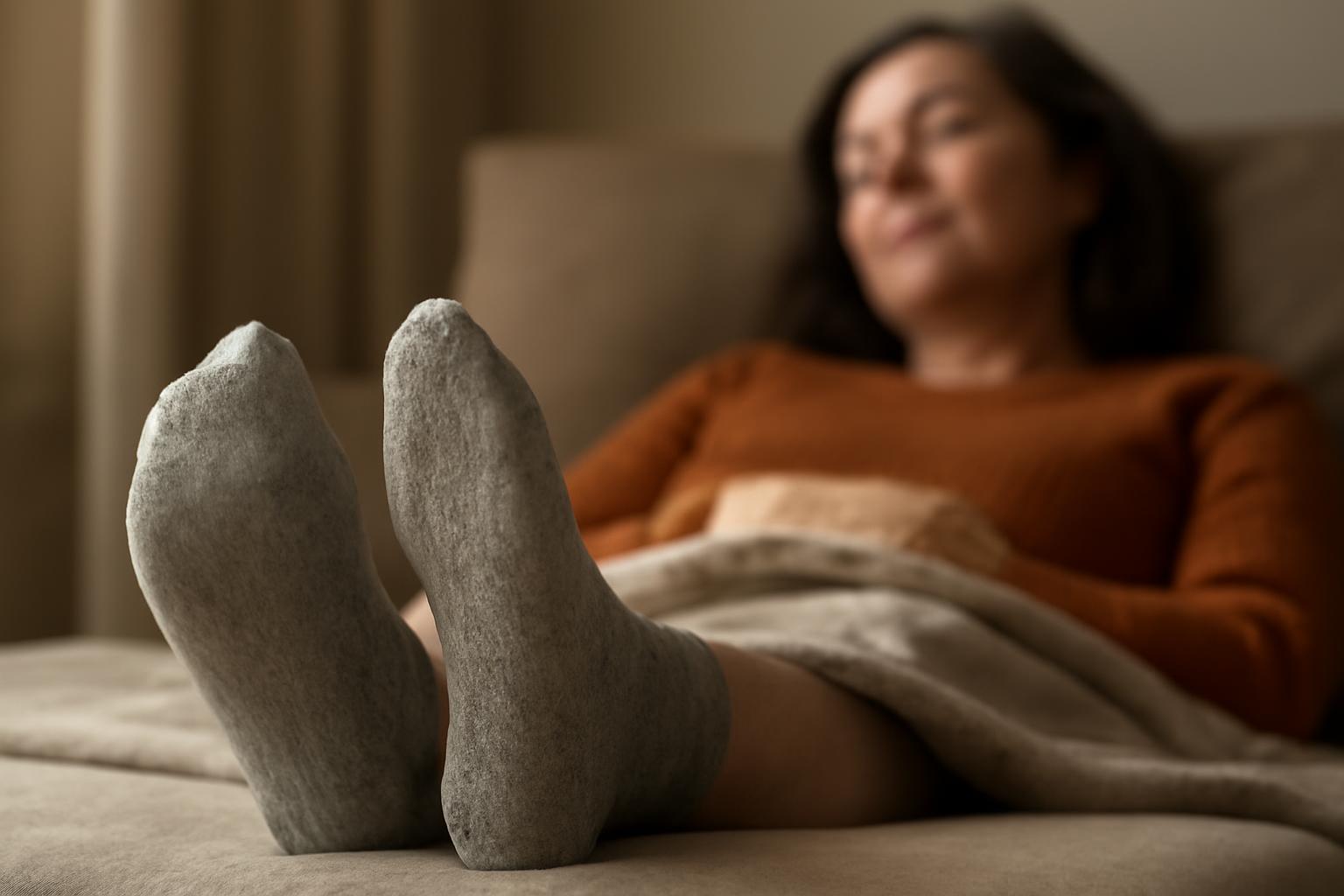
NapHelp usually covers sleep and nap science, not gadgets. That matters here, because grounding socks sit squarely in the wellness-product category. The useful question is not which pair to buy. It is whether there is independent evidence that grounding socks improve sleep, naps, or daytime alertness.
Based on the evidence reviewed for this article, the answer is cautious and limited: grounding socks are marketed as conductive garments that may let users “earth” or “ground” indoors or outdoors, but no peer-reviewed sleep trials specifically testing grounding socks were identified in this evidence set. The research that grounding brands and summaries point to is broader earthing research involving barefoot contact, mats, sheets, or other grounded products, usually in small studies and with ongoing debate about interpretation.
That does not mean grounding socks are fake products. It means the leap from conductive sock to better sleep has not been independently established here. For readers with insomnia, suspected sleep apnea, or daily daytime sleepiness, the evidence is much stronger for sleep-timing basics, nap duration, and clinical evaluation than for conductive footwear accessories.
What Are Grounding Socks?
The clearest descriptions of grounding socks in the reviewed evidence come from seller pages, so this section is best read as a market description, not as independent product validation.
In those listings, grounding socks are described as socks made with conductive fibers, usually silver-based threads, woven into more ordinary sock materials such as cotton, organic cotton, merino wool, or fabric blends. One seller described a 70% cotton and 30% silver-fiber blend; another described merino wool or organic cotton with silver thread woven throughout. The evidence set also shows that “earthing socks” and “grounding socks” are used as overlapping retail terms.
Across the reviewed listings, common features included:
- conductive silver thread or other conductive fibers
- cotton, organic cotton, merino wool, or blended fabrics
- no-show, low-cut, crew, and five-toe styles
- typical listed pricing in roughly the $19 to $30 per pair range
That tells you what the category looks like in the marketplace. It does not tell you that the products work for sleep.
The reviewed seller material also suggests that “grounding socks” can refer to two slightly different product concepts:
- Outdoor conductive socks, sold for use on conductive natural surfaces or with grounding footwear
- Indoor plug-in socks, sold as one part of a grounded system that may include a cord, snap, mat, or outlet-ground connection
That distinction matters because the products are not all doing the same thing. A sock intended for barefoot-style outdoor use is different from a sock that only functions as part of a plug-in setup.
For sleep readers, the practical takeaway is simple: grounding socks are a real niche product category sold in recognizable styles and materials. But the existence of a product category is much weaker than proof of clinical benefit.
How Do Grounding Socks Claim to Work?
Again, most of the detail here comes from product pages, brand blogs, and commercial explainers, not neutral testing. So the right framing is “how sellers say they work,” not “how independent research has confirmed they work.”
The basic claim is electrical. Grounding socks are said to use conductive threads to create a path between the skin and a grounded surface.
Indoors
In seller explanations, indoor grounding socks usually work only as part of a larger setup:
- conductive fibers touch the skin
- a snap or cord connects the sock to a grounding mat, sheet, or outlet ground port
- that connection is said to provide a route for electrical grounding or electron transfer
This is important because many indoor grounding socks are not really standalone socks in the ordinary sense. They are accessories within a plug-in grounding system.
Outdoors
For outdoor use, the claim is simpler. Sellers say the socks can be worn on surfaces presented as conductive, such as:
- grass
- soil
- sand or wet sand
- some natural stone
- some concrete or unsealed tile, depending on the seller
The reviewed sources also repeatedly say that moisture helps conduction. That is one reason these pages discuss sweat, damp fabric, and natural fibers so often. In that seller logic:
- bare skin is the strongest contact
- thick, dry regular socks tend to insulate
- thin natural-fiber socks may conduct a little if damp
- purpose-built conductive socks are sold as a better option than ordinary socks when barefoot contact is impractical
That is a coherent product claim. It is not the same as a clinically validated sleep intervention.
Why regular socks are different
On this point, even the favorable sources are fairly aligned: ordinary thick, dry socks are usually described as barriers rather than helpers.
A non-seller community answer and a commercial grounding explainer both make the same basic point: sweat and ions may allow some conduction through thin natural-fiber socks, but this is slower, weaker, and less reliable than direct skin contact. Regular socks are therefore not equivalent to grounding socks, and neither is typically described as better than barefoot contact.
So if someone asks whether normal socks let you ground, the careful answer from this evidence set is: possibly a little under favorable conditions, but not reliably enough to treat them as a substitute for direct contact.
Care and maintenance
Care instructions also come mostly from sellers. Common recommendations include:
- mild detergent
- no bleach
- no fabric softener
- air dry or avoid high heat
- avoid lotions, oils, or creams on the contact area before use
These instructions do not prove any health benefit. They simply fit the internal logic of conductive textile products: if conductive fibers are coated, damaged, or oxidized, sellers say conductivity may decline.
So yes, grounding socks are sold as conductive products with a recognizable technical story. But that story remains a product claim until independent evidence shows a meaningful sleep or alertness outcome.
Claimed Sleep Benefits of Grounding Socks
This is where the marketing and the evidence separate most sharply.
Seller pages and promotional articles in the reviewed evidence commonly claim that grounding socks may help with:
- better sleep
- deeper sleep
- less stress or anxiety
- lower inflammation
- pain relief
- improved circulation
- better mood or energy
- normalized cortisol
Some product pages also include customer testimonials about sleeping better, feeling calmer, waking with more energy, or having less pain or swelling. Those reports may be sincere. They are still anecdotes collected in a sales context, which makes them weak evidence.
What matters most for a sleep-focused reader is this: in the reviewed evidence, no peer-reviewed sleep trials specifically testing grounding socks were identified. That includes no sock-specific trials for insomnia, daytime sleepiness, naps, or obstructive sleep apnea in this evidence set.
That leaves a much weaker chain of reasoning:
- grounding or earthing in general has been studied a little
- some of that broader research reported sleep-related or physiological changes
- sellers infer that grounding socks should deliver similar benefits
That inference may be commercially understandable, but it is still an inference.
Why the sock-specific gap matters
A sock is not the same intervention as a sheet, mat, patch, or direct barefoot contact. Compared with those formats, socks usually involve:
- less total skin contact
- contact mostly at the feet
- more dependence on fit and moisture
- more setup variability indoors
- more uncertainty about consistency during sleep
Even seller comparisons sometimes reflect this limitation. Promotional comparisons between socks and sheets often describe sheets as more practical for overnight use because sheets offer more contact area and longer, more passive exposure.
That does not prove grounding sheets work for sleep either. It does, however, show that even within the grounding marketplace, socks are often positioned as a narrower or more situational format.
What can be said fairly
A fair summary of the reviewed evidence is:
- grounding socks are marketed for sleep and recovery
- seller testimonials often report sleep improvement
- broader grounding studies are sometimes cited in support
- but no sock-specific peer-reviewed sleep trials were identified in this review
For anyone trying to solve insomnia, nap grogginess, or unexplained daytime fatigue, that is the key fact.
Scientific Evidence on Grounding and Sleep
The broader grounding literature is limited, indirect, and still disputed.
A medically reviewed WebMD summary in the evidence set describes grounding research as having “not a lot of solid research.” It notes that a few studies have reported possible benefits such as reduced inflammation, lower stress, improved blood flow, lower blood pressure, and better sleep. It also mentions a small study reporting normalized nighttime cortisol and improved sleep.
That is the strongest independent summary in this evidence pack, and even it is cautious.
What the strongest pro-grounding case looks like
If you wanted to present the most favorable evidence-based argument for grounding in general, it would look something like this:
- some small studies have reported changes in inflammatory indicators
- some have reported changes in blood viscosity or blood pressure
- some have reported improved sleep questionnaires or nighttime cortisol patterns
- the underlying theory is that contact with the earth or a grounded system changes electrical exposure at the body surface
- some users report subjective benefits
That is a real argument. It is just a preliminary one.
Why the evidence is still weak
Several limitations recur across the reviewed sources:
- small samples
- few large randomized controlled trials
- uncertain blinding and expectation effects
- mixed interventions grouped together under “grounding”
- limited replication
- no direct sock-specific sleep evidence identified here
This matters because even if a small grounding study reported better sleep, it still would not answer several practical questions:
- would socks work the same way as mats, sheets, or barefoot contact?
- would the finding hold up in a larger sham-controlled trial?
- would the change be clinically meaningful?
- would it help people with insomnia, sleep apnea, or hypersomnolence?
At present, the reviewed evidence does not let us answer those questions confidently.
The placebo and expectation issue
Sleep outcomes are especially vulnerable to expectation effects. If users are told that a product may calm the nervous system, balance cortisol, reduce inflammation, and improve sleep, self-reported sleep quality can shift even without a strong specific mechanism.
That does not prove grounding effects are imaginary. It means that testimonials and unblinded self-reports are not enough.
The most responsible bottom line on the science
A cautious, evidence-based conclusion is:
- grounding research in general is preliminary
- some small studies suggest possible sleep-related or physiological effects
- the evidence remains debated and not definitive
- the reviewed evidence did not identify peer-reviewed sleep trials specifically on grounding socks
That is a much narrower claim than “grounding socks improve sleep,” and it is the claim the evidence can actually support.
Limitations: Socks vs Barefoot or Proven Nap Strategies
If the only question were electrical contact, the reviewed sources are remarkably consistent on one point: direct skin contact is presented as the strongest grounding setup. Grounding socks are offered as a workaround for convenience, weather, or practicality.
That workaround has obvious limitations.
1. Socks add variability
Even favorable sources describe socks as less direct than bare skin. Once a sock sits between the body and the surface, the result depends on several factors:
- fiber composition
- how closely the sock contacts the skin
- moisture or perspiration
- thickness
- number of fabric layers
- whether another layer, such as a fitted sheet or ordinary sock, is involved
Some reviewed seller material says one thin natural-fiber layer may still permit grounding in certain conditions. Other reviewed material says socks reduce or block the effect unless the skin is bare. Those positions are not identical, but they point in the same direction: socks introduce uncertainty.
2. Regular socks can reduce or block mat and sheet contact
This is one of the clearest practical limits in the evidence set. Several sources say grounding mats and similar products work best with bare skin and may be weakened or blocked by ordinary socks. A related seller source says one thin natural-fiber layer may still work in some setups, but even there it is framed as second-best, not ideal.
3. Foot-only contact is a narrow sleep setup
For overnight use, socks cover the feet, not the whole body. Sellers who prefer sheets over socks often explain that sheets provide larger surface area and longer passive use. Because that comparison mostly comes from commercial sources, it should be read as market positioning, not neutral proof. Still, it highlights a practical issue: socks are a smaller-contact format.
4. Evidence-based nap strategy has a much stronger research base
This is where the comparison becomes less about mechanism and more about evidence quality.
NapHelp’s nap-length review summarizes a much clearer literature on daytime alertness. Its main conclusions are:
- 10 to 20 minutes is the standard power-nap range
- 30 to 60 minutes often produces the worst sleep inertia
- 90 minutes can work when repaying real sleep debt or preparing for unusually extended wakefulness
NapHelp also cites a 2006 NASA study in sleepy military pilots: a 26-minute nap improved alertness by 34% and performance by 16%.
That is not a head-to-head trial against grounding socks. But it is a much stronger kind of evidence for improving daytime function than anything in this grounding-sock evidence pack.
5. Caffeine naps are supported more directly for alertness
NapHelp’s review also highlights the caffeine nap: take 100 to 200 mg of caffeine immediately before a short nap, so caffeine begins working as you wake. Its summary says multiple studies show better alertness from the combination than from either caffeine or a short nap alone.
Again, that is not proof that grounding socks do nothing. It is a comparison of evidence strength. If the goal is reliable afternoon alertness, the support for short naps and caffeine timing is considerably stronger than the support for conductive socks.
6. Napping is not always the right target
NapHelp’s separate article on when napping makes things worse is especially relevant for readers drawn to gadgets because they feel tired all day.
That review argues that napping may backfire or distract from the real issue in several situations:
- chronic insomnia, because naps reduce sleep pressure and CBT-I restricts daytime napping for this reason
- chronically short night sleep, because a long daily nap can preserve the pattern rather than fix it
- depression, where long naps correlate with worse depressive symptoms, though direction remains debated
- suspected sleep apnea, where daily nap need despite a full night in bed is a warning sign, not a nap-optimization problem
- high-stakes evening performance, where a long late nap can cause sleep inertia at the wrong time
Grounding socks do not address any of those mechanisms. They do not increase sleep pressure, treat fragmented breathing during sleep, or prevent waking from deep sleep at the wrong point in a nap.
Bottom line on the comparison
If the question is whether grounding socks are likely to be the strongest version of grounding itself, the reviewed evidence points to no: direct contact is consistently presented as stronger.
If the question is whether grounding socks have evidence support comparable to nap-duration science for alertness and daytime function, the answer is also no: the nap evidence is much better developed.
Safety Considerations and Outlet Checks
Grounding socks are often presented as low-risk wellness products, but safety still matters, especially with plug-in systems.
Check outlet grounding before plug-in use
Seller instructions in the reviewed evidence repeatedly advise checking that the outlet is properly grounded before using a plug-in grounding product. One seller example says to use an outlet checker and look for the light pattern indicating a correct ground; that example specifies two amber lights, but users should follow the tester’s own legend and local electrical standards rather than assume one pattern applies universally.
If the outlet does not test as properly grounded, the reviewed seller instructions suggest either using a different outlet or, in some systems, a grounding rod.
That recommendation comes from product-use material, not an independent electrical-safety standard, so it should be read conservatively: if a product depends on outlet grounding, verify the outlet properly before use.
Avoid common setup mistakes
The reviewed product instructions commonly say to:
- avoid bleach and fabric softener
- avoid high heat when drying
- avoid lotions, oils, or creams on contact areas
- keep conductive areas clean
- avoid use in unsafe electrical conditions
Some sources also warn against thunderstorms or improper outlet conditions. Those are sensible cautions, especially where a corded grounding system is involved.
Do not substitute grounding socks for medical care
This point is much firmer than the product details: grounding socks are not established medical treatment for:
- insomnia
- obstructive sleep apnea
- excessive daytime sleepiness
- depression-related fatigue
- chronic pain disorders
The WebMD summary in the evidence set explicitly says grounding’s health benefits are unproven and that it should never replace medical treatment. That is the right standard here.
Seek clinical evaluation rather than self-experiment alone if you:
- feel sleepy daily despite enough time in bed
- snore loudly or wake choking
- have ongoing insomnia
- wake unrefreshed after what should be a full night
- fall asleep unintentionally
- have nerve, foot, or circulation issues that may affect safe use
Informational limits
NapHelp’s own terms also matter. NapHelp states that its content is general information, not medical advice; it does not guarantee accuracy or fitness for a particular purpose; and it is not liable for decisions made based on site content. Readers with sleep disorders, excessive daytime sleepiness, or other health concerns are advised to consult a qualified healthcare provider.
NapHelp’s Evidence-Based Nap Recommendations
If your actual goal is better daytime function, NapHelp’s guidance is much more actionable than grounding-product marketing.
The default nap: 10 to 20 minutes
NapHelp’s nap-length review argues that the most reliable nap for most people is:
- 10 to 20 minutes
- usually before 3 pm if bedtime is around 10 to 11 pm
The reasoning is straightforward: this range usually keeps you out of deep slow-wave sleep, so you wake faster and with less sleep inertia.
The recovery nap: 90 minutes
A 90-minute nap can make sense when you are meaningfully sleep-deprived or need a full cycle before an unusual demand, such as extended evening work or a night shift. NapHelp presents this as a specific tool, not a routine fix for chronically poor night sleep.
That distinction matters. A long daily nap can become a way of preserving inadequate nighttime sleep.
Avoid the 30-to-60-minute range
NapHelp’s clearest warning is about the middle zone. Around 30 to 60 minutes, many people wake from slow-wave sleep and feel worse for 20 to 30 minutes afterward.
If your experience is “naps make me groggy,” duration is often the first thing to review.
Use caffeine strategically
For more predictable alertness, NapHelp favors the caffeine nap:
- take 100 to 200 mg caffeine
- lie down immediately
- keep the nap short, around 15 to 20 minutes
- finish early enough that it does not push bedtime later
This is presented as a lower-variance strategy than gambling on a long late-afternoon nap.
When not to optimize naps
NapHelp is also clear that sometimes the problem is not nap technique at all.
Cases where nap optimization may be the wrong target include:
- chronic insomnia, because CBT-I restricts naps
- suspected sleep apnea, because daily nap need can be diagnostic
- depression, where longer naps correlate with worse symptoms
- chronically short night sleep, where the main fix is nighttime sleep, not a daytime patch
That is directly relevant to grounding socks. Many people who look for sleep gadgets are trying to solve excessive fatigue. Often the better next step is diagnosis or behavior change, not a new product category.
Grounding Socks vs Alternatives for Rest
So should you buy grounding socks?
The best answer depends on what you expect them to do.
If your goal is curiosity or convenience
Grounding socks make the most sense as a convenience product for someone already interested in grounding. In that narrow role, the logic is understandable:
- they may be easier than going barefoot in cold or inconvenient settings
- they are more intentional than ordinary socks
- they may fit with grounding shoes, mats, or plug-in systems
That is a lifestyle use case, not an evidence-based sleep treatment.
If your goal is overnight passive use
Even within grounding marketing, sheets are often positioned as more practical for overnight use because they provide broader contact area and longer passive exposure. Since that comparison is largely seller-driven, it should not be mistaken for independent proof. Still, it reflects a practical limitation of socks: they only contact the feet and often depend on a more fiddly setup.
If your goal is better sleep, better naps, or less daytime sleepiness
This is where the answer changes.
If you want to:
- fall asleep faster
- stop waking groggy
- nap without harming bedtime
- improve daytime alertness
- understand why you feel tired despite enough time in bed
then grounding socks should be low on the list of priorities.
Based on the evidence reviewed here, higher-yield steps include:
- improving sleep schedule consistency
- using evidence-based nap lengths
- avoiding late naps that reduce bedtime sleep pressure
- using caffeine strategically rather than randomly
- reviewing basic sleep habits
- getting evaluated when symptoms suggest insomnia or sleep apnea
That fits NapHelp’s editorial stance: peer-reviewed sleep research first, gadget skepticism by default.
A practical decision rule
A reasonable decision rule is:
- Consider grounding socks only as an optional comfort or curiosity product.
- Do not treat grounding socks as an evidence-based solution for insomnia, sleep apnea, or unexplained fatigue.
- When the goal is alertness or sleep quality, give more weight to nap-duration science and clinical evaluation than to seller claims about grounding products.
The peer-reviewed reality is not that grounding socks have been disproven. It is that, in the reviewed evidence, they remain an unproven sleep accessory supported mainly by marketing, indirect grounding research, and anecdote.
Do regular socks allow grounding?
Usually not in any reliable way. The reviewed evidence consistently says thick, dry regular socks tend to insulate rather than help. A few sources say thin, damp natural-fiber socks may allow some conduction because sweat provides moisture and ions, but they also describe that as weaker and less dependable than bare skin. So regular socks are not a practical substitute for direct contact, and they are not equivalent to purpose-built grounding socks either.
Can grounding socks help insomnia or sleep apnea?
No peer-reviewed sock-specific trials for insomnia or sleep apnea were identified in the reviewed evidence. More broadly, grounding research is limited and preliminary, and the available sleep-related findings are not specific to socks. For chronic insomnia, NapHelp’s guidance points to CBT-I-style sleep-pressure management rather than daytime napping or gadgets. For suspected sleep apnea, persistent daytime sleepiness or daily nap need despite enough time in bed should prompt clinical evaluation.
How to test if outlets work for plug-in socks?
Use an outlet tester and confirm that the outlet shows the pattern marked as properly grounded on that tester. One reviewed seller instruction used two amber lights as the correct pattern, but the safer general rule is to follow the tester legend and local electrical standards. If the outlet does not test correctly, do not assume it is suitable for a plug-in grounding product.
What nap lengths are evidence-based?
NapHelp’s review supports three practical nap categories:
- 10 to 20 minutes for a power nap with less sleep inertia
- 30 to 60 minutes as the range most likely to leave you groggy
- 90 minutes for a full cycle when you are significantly sleep-deprived
NapHelp also recommends keeping naps before 3 pm for most people targeting a 10 to 11 pm bedtime, and it highlights the caffeine nap as a useful short-alertness strategy.
Is NapHelp content medical advice?
No. NapHelp states that its content is for general informational purposes only, is offered without guarantees of accuracy or fitness for a specific purpose, and is not medical advice. It also says NapHelp Media is not liable for decisions made based on site content. If you have a sleep disorder, excessive daytime sleepiness, or another health concern, consult a qualified healthcare provider.