
4 min read ·
What a 90-Minute Nap Can—and Cannot—Do
A 90-minute nap may help memory, attention, mood, and exercise performance. See what studies tested and why a full sleep cycle is not guaranteed.
Written by
Staff research and writing, reviewed against the sources listed at the foot of every article.
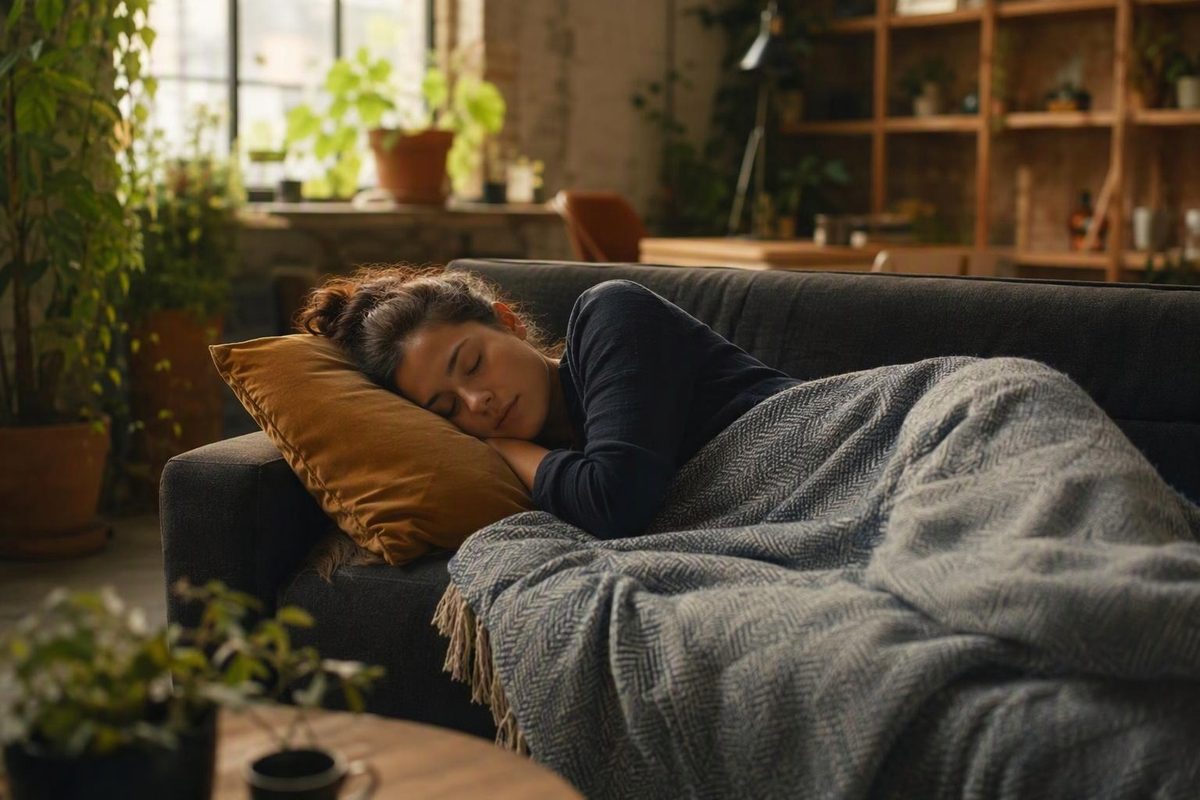
A 90-minute nap may support memory retention and improve attention, mood, and some exercise-performance measures. It is worth considering when you have a longer afternoon rest window and time to wake up afterward—not when you need an immediate, grogginess-free boost.
The evidence supports possible benefits from a longer nap, not a special benefit that begins at exactly 90 minutes. Studies often test a 90-minute opportunity to sleep, rather than 90 minutes of uninterrupted sleep. Nor does that duration guarantee a complete sleep cycle.
What benefits have actually been demonstrated?
Remembering material learned before the nap
In a laboratory study involving 50 young adults aged 18–29 and 45 older adults aged 58–83, participants learned words before a 90-minute nap opportunity or an equal period of quiet wakefulness. Young adults in the nap condition subsequently recalled and recognized more words. The older adults did not show the same memory advantage. The young nappers averaged about 73 minutes of actual sleep, illustrating why the study is not evidence for an exact 90-minute sleep requirement. Researchers also allowed participants still in deep or REM sleep at the end of the nap window to sleep until their first spontaneous arousal, rather than waking everyone at a fixed alarm. Study and sleep measurements
An earlier experiment found that 60–90-minute naps containing both slow-wave sleep and rapid eye movement (REM) sleep improved performance on a visual texture-discrimination task. The improvement resembled that seen after a full night of sleep on that particular task. It did not show that a nap replaces a night’s sleep for health, alertness, or overall functioning. Original perceptual-learning study
Practical meaning: A longer nap after studying or practicing a perceptual skill may help preserve what you learned. These findings do not establish that 90 minutes is better than every shorter nap, or that everyone—including older adults—gets the same memory benefit.
Better attention and less sleepiness
A randomized crossover study tested no nap, a 40-minute nap opportunity, and a 90-minute opportunity in 14 young amateur team-sport players following normal nighttime sleep. Both nap conditions improved a timed attention test and reduced reported sleepiness compared with no nap; the 90-minute condition produced greater improvements than the 40-minute condition. Original athlete study
That is encouraging, but it is a small, specific sample—not proof that a 90-minute nap improves every kind of thinking. Nap sleep was assessed subjectively, without a sleep-lab recording to establish actual sleep duration or stages. Attention testing began 75 minutes after the longer nap ended, so the results also do not promise better performance immediately after waking.
Better mood and some exercise-performance measures
In the same athlete study, the longer nap improved overall mood scores, maximal isometric leg force, and total distance covered during repeated shuttle runs compared with both no nap and the 40-minute opportunity. After the exercise test, participants also reported less exertion and soreness and better perceived recovery. Results and protocol
These are short-term performance and subjective-recovery findings. Feeling more recovered does not establish faster muscle repair or growth, and better mood scores do not make a long nap a treatment for depression. For rest after exercise, see napping after a workout.
Why “one full sleep cycle” is not a reliable promise
The attraction of 90 minutes is that a longer nap provides an opportunity for more than light sleep. But sleep does not follow a universal 90-minute timer. NHLBI describes nighttime cycles as restarting roughly every 80–100 minutes; that range is not a precise nap-alarm rule. Time spent falling asleep and periods awake further separate time in bed from time asleep. NHLBI sleep-stage guidance
A 90-minute alarm therefore cannot guarantee REM sleep, a completed cycle, or an easy awakening. Sleep inertia—the temporary decline in alertness and performance after waking—can still occur. NIOSH advises allowing it to dissipate before critical tasks, especially because sleep deprivation can prolong it. NIOSH sleep-inertia guidance
When the benefits are worth the time
If you want to try a 90-minute nap opportunity:
- Use an early-afternoon window rather than letting it drift toward bedtime. In a small study of 14 student athletes, a 90-minute opportunity from 1:30 to 3 p.m. did not significantly disrupt the following night’s sleep, assessed using wrist actigraphy. That supports this timing in that population, not a universal guarantee. Nighttime-sleep study
- Reserve time after the alarm. Do not schedule driving or safety-critical work immediately afterward. A wake-up buffer is part of the time cost, not an optional extra.
- Judge both the afternoon and the night. Look for improved alertness or useful work later, but also whether you take longer to fall asleep that evening. NHLBI’s general advice favors naps of no more than 20 minutes and recommends limiting or moving naps earlier if nighttime sleep is difficult. A 90-minute nap is therefore a longer option to assess, not the default daily prescription. Healthy-sleep guidance
If your main goal is a quick alertness boost, you do not need 90 minutes: brief naps also have evidence behind them. See the nap-length guide for shorter options. Naps remain a temporary aid, not a replacement for regular, adequate sleep. NIOSH guidance
Persistent daytime sleepiness—particularly with loud snoring, gasping, or witnessed breathing pauses—deserves a healthcare assessment rather than simply a longer nap. Those can be symptoms of sleep apnea. NHLBI symptom guidance