
18 min read ·
Soft Cervical Collars at Night: Tolerated but No Proven Benefits for Severe Sleep Apnea
A severe OSA pilot found no significant group-level improvement in its main apnea metrics. Soft collars also provide only limited motion restriction.
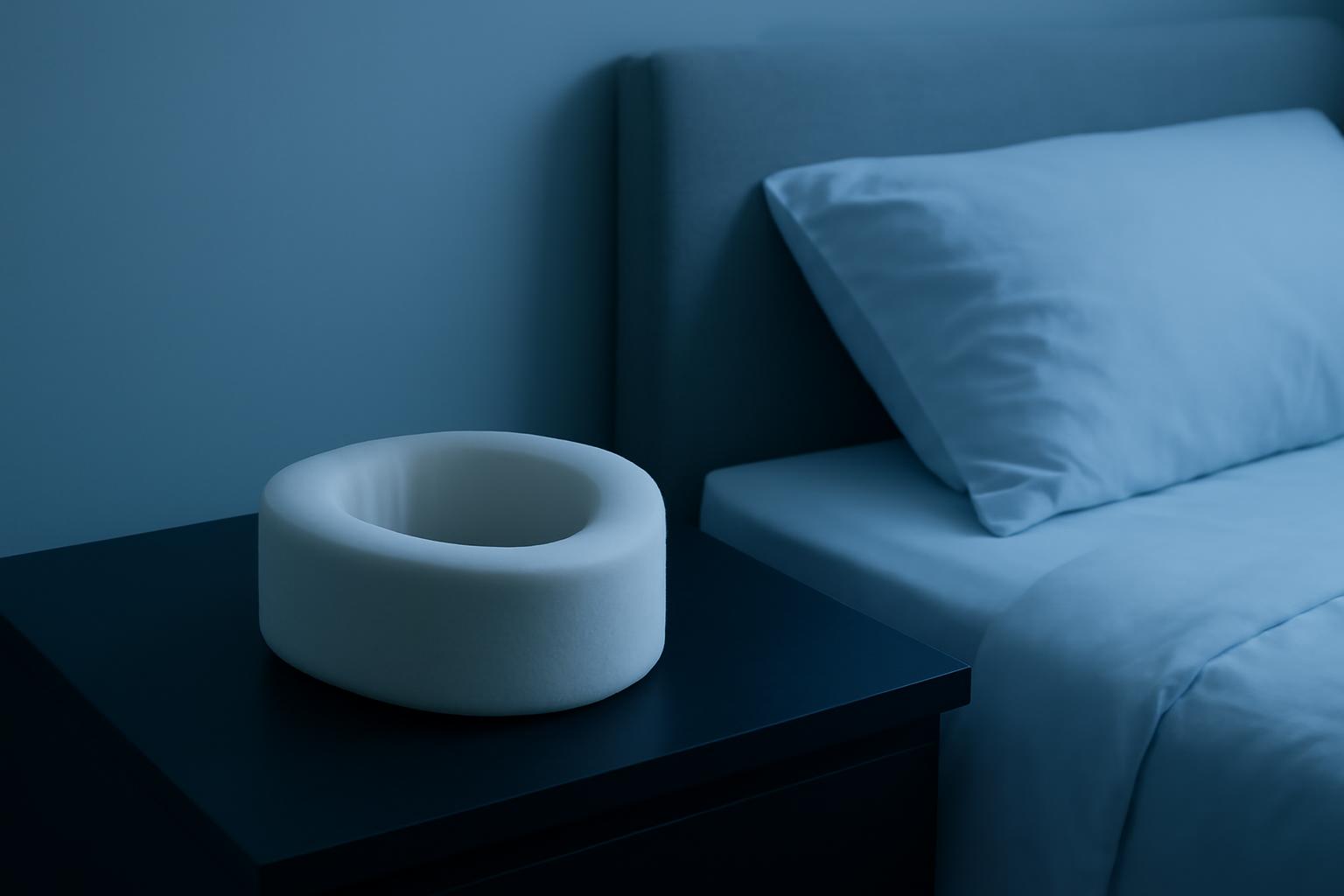
Soft cervical collars at night were tolerated by most participants in one small, one-night pilot of severe obstructive sleep apnea, but the study did not show significant group-level improvement in the main apnea metrics researchers measured.1
If you are considering a cervical collar for sleeping because of sleep apnea, daytime sleepiness, or neck pain, the evidence is much narrower than many product pages imply. The most relevant sleep-apnea study is a 2021 pilot trial in people with severe obstructive sleep apnea (OSA). In that study, most participants could wear a soft cervical collar for one night, but the collar did not significantly improve the main breathing outcomes: apnea-hypopnea index (AHI), oxygen desaturation index (ODI), or oxygen saturation (SaO2) at the group level.1
For neck pain, the literature points in a different direction. Soft collars are not true immobilizers. Review evidence suggests they still allow a large share of normal neck motion, and one whiplash study summarized in the clinical literature found only about a 17% reduction in movement—not enough for real immobilization.23 Some patients do report short-term symptom relief, but that is not the same as better long-term recovery, and prolonged use raises concerns about stiffness and muscle deconditioning.23
So the practical answer is not “never,” but it is also not “research supports routine self-directed nightly use.” A cervical collar has a clear medical role when a clinician prescribes it for an injury, fracture, surgery, or another defined condition. That is different from using a soft foam collar on your own to improve sleep apnea or ordinary nighttime neck discomfort.24
What Is a Cervical Collar and Its Intended Role in Sleep
A cervical collar is a device designed to support the neck and cervical spine while limiting head and neck movement. Its standard medical role is short-term stabilization in settings such as neck injury, surgery, acute pain, nerve irritation, or—when a more rigid device is used—cervical fracture care.24
That distinction matters because people searching for a cervical collar for sleeping often combine very different devices and goals under one label:
- Soft collars are typically made from foam or similar flexible material and are used for milder support.2
- Hard collars use more rigid structures and are used when restriction matters more, such as after fractures or some operations.24
A soft collar can provide support and may remind the wearer not to move into painful positions, but that is not the same as immobilizing the neck. Review evidence found that soft collars still permit about 74% of normal flexion-extension, 92% of lateral bending, and 83% of rotation.3 In a whiplash study summarized in clinical guidance, soft collars reduced movement by only a little over 17%, which was judged inadequate for immobilization.2
Hard collars are different, but even they are not magical “freeze the neck” devices. Clinical patient guidance for prescribed hard collars explains that the goal is to limit movement during healing, not eliminate it entirely.4 Those same guides emphasize proper fit and posture because motion control still depends on anatomy, positioning, and correct use.4
For sleep, the intended role depends on the reason for wearing the collar:
- For injury or surgery, the goal is structural protection when you cannot consciously control movement.
- For acute neck pain, the goal is usually short-term symptom relief and modest motion reduction.
- For sleep apnea, the proposed idea is different: reducing head flexion-extension or jaw drop that might worsen upper-airway collapse.1
Those uses do not share the same evidence base. Evidence that collars are useful after trauma or surgery does not mean a soft collar has been shown to improve sleep apnea or routine nightly neck pain. And the common assumption that a soft collar will “hold the neck still” overnight is not supported by the motion data.23
Pilot Study: Soft Collars in Severe Obstructive Sleep Apnea Patients
Evidence tier: pilot study. The most relevant peer-reviewed sleep-apnea evidence is a 2021 pilot study in adults with severe OSA, defined as AHI 30 or more events per hour.1
The study enrolled 20 patients total:
- 10 wore a soft cervical collar for one night
- 10 served as controls1
Researchers compared baseline sleep-polygraphy results with a second night and also compared the intervention and control groups. The rationale was mechanically plausible: a soft collar can limit head flexion-extension and mandible motion, which might reduce upper-airway collapse in some people, especially in a supine-sleep setting.1
But in this study, that theory did not translate into a clear group benefit.
The paper reported no statistically significant group differences in the key outcomes researchers measured:
- AHI
- ODI
- SaO21
The study summary notes that the relevant reported p values were above 0.002, and the practical bottom line is straightforward: the soft collar did not significantly improve the main breathing metrics in this sample.1
One participant in the collar group did have a notable response, with about a 67% reduction in AHI. That is interesting, but it does not establish efficacy. Pilot studies often produce individual outliers that are useful for hypothesis generation, not proof.1
The authors were cautious about that distinction. Based on the observed effect size, they estimated that a future randomized trial would need roughly 123 participants per group to adequately test the question.1 That points to an underpowered pilot, not a near miss.
A few limits are important:
-
This was severe OSA only. The study does not support using soft collars in place of established OSA treatment.1
-
This was a one-night test. It tells us very little about long-term adherence or whether a subgroup might benefit after adaptation.1
-
The mechanism stayed theoretical. The collar may have limited jaw or head position, but that did not become a measurable overall improvement in AHI, ODI, or oxygen saturation in this group.1
So if the question is, “Does research show that wearing a soft cervical collar overnight improves severe sleep apnea metrics?” the best evidence-based answer is: not in the small one-night pilot we currently have.1
Tolerance and Discomfort in Overnight Collar Use for OSA
Evidence tier: pilot-study tolerability data. Lack of efficacy is not the same as lack of tolerability. One reason the severe-OSA pilot still matters is that it looked at whether people could actually sleep in the device.1
Among the 10 participants assigned to the collar:
- 9 completed the night with it on
- 1 removed it because of a choking sensation1
The most commonly reported discomfort was heat.1 That is a useful practical detail because consumer descriptions often frame collars as simple “support,” while actual overnight barriers may be warmth and a feeling of constriction.
When participants were asked whether they would wear the collar every night:
- 5 of 10 said yes
- 2 of 10 said no
- 3 of 10 were unsure1
That is not strong enthusiasm, but it also is not blanket rejection. A fair summary is: most participants tolerated a soft collar for one night, but interest in nightly use was modest.1
The study also reported that participants spent more than 99.5% of sleep time supine, and investigators did not find worsening of dorsal or supine AHI.1 So the collar did not improve OSA overall, but in this tiny sample it also did not appear to make back-sleep breathing worse.
Fit was another real-world limit. Three potential participants were excluded because of neck size, and one person refused participation.1 That matters because collar use is not only about willingness; it is also about anatomy. If the device does not fit safely or cannot meaningfully influence jaw and neck position, the whole concept breaks down.
This is also where device class matters. A soft collar used experimentally for OSA is not the same as a rigid collar prescribed after fracture or surgery. Comfort, pressure, motion control, and breathing sensation can differ substantially.14
For someone thinking about a cervical collar for sleeping because of sleep apnea, the overnight-tolerance evidence supports three restrained conclusions:
- Some people can tolerate a soft collar overnight
- Discomfort is common enough to matter, especially heat and choking sensation
- Tolerance does not equal treatment benefit1
That last point is the key one. A device can be wearable and still not meaningfully improve apnea.
Motion Restriction and Limited Efficacy for Neck Pain
Evidence tier: review evidence and whiplash literature. The case for a cervical collar for sleeping is often framed in neck-pain terms: support, alignment, posture, reduced strain. Some of that is plausible at the symptom level. The problem is that the better clinical literature does not show strong immobilization or strong long-term outcome benefit from soft collars.23
A peer-reviewed review of cervical collars and neck pain reported that soft collars still allow substantial motion:
- 74% of normal flexion-extension
- 92% of normal lateral bending
- 83% of normal rotation3
Those numbers do not describe true immobilization. They describe partial restraint.
That matches the whiplash study summarized in clinical guidance, where 50 patients wearing soft collars showed only a little over 17% reduction in movement, which the authors considered inadequate for immobilization.2 So if someone imagines that a soft collar will hold the neck still all night and therefore solve a pain problem, the mechanical evidence does not support that expectation.
At the same time, soft collars are not meaningless. The same review reported that 76% of patients experienced symptomatic pain relief with soft-collar use.3 That is worth taking seriously—but carefully. A device can reduce symptoms without meaningfully changing the underlying course of recovery.
Possible reasons for short-term relief include:
- a reminder to avoid painful movement
- mild support
- sensory feedback from pressure or warmth
- temporarily reduced fear of sudden neck motion
The whiplash literature is especially important here. Across multiple studies summarized in the review, early mobilization and exercise performed better than collar immobilization for pain and function.3 The message is not that collars are always wrong. It is that routine reliance on them can be counterproductive when active recovery is more effective.
The evidence gap is also important. Reviews note that there is no strong evidence for long-term outcome benefit from cervical collars in common neck-pain problems, and that soft-collar prescribing has often been driven partly by anecdote and habit.3
So for neck pain, the fairest summary is:
- Soft collars may offer temporary symptom relief
- They provide only limited motion restriction
- They are not effective immobilizers
- In whiplash, early movement-based care often performs better23
That does not make a soft collar irrational in every case. It does mean expectations should stay modest, especially if the plan is night-after-night use.
Risks of Prolonged or Nightly Cervical Collar Use
Evidence tier: review evidence plus clinical guidance. The main risk question is not whether a collar feels awkward for one night. It is whether repeated or prolonged use creates new problems.
The most consistent concern is muscle deconditioning. Review evidence notes that longer-term collar use may weaken and stiffen the neck musculature.23 One review cited animal-model evidence showing signs of muscle atrophy after about one week of immobilization.3 That does not prove the same timeline for humans using soft collars at night, but it supports the broader caution that immobilization has a cost.
That concern also shows up in clinical hard-collar guidance. Patient instructions explain that collar use can cause some neck-muscle weakness because the device is doing part of the work those muscles normally do.4
Beyond weakening and stiffness, repeated collar use may contribute to:
- reduced normal movement
- deconditioning
- heat and discomfort that disrupt sleep rather than improve it123
The risk profile differs by collar type.
Soft collars
Soft collars are generally used for milder support or moderate pain, not for major structural instability.2 Their risks are less dramatic than those of hard collars, but the tradeoff is also different: they provide limited restraint, have thin evidence for long-term benefit, and may encourage over-reliance if used as an open-ended nightly habit.23
Hard collars
Hard collars are a different category. They are used when clinicians need more motion restriction, such as after some fractures or surgeries.4 Review-level concerns around more rigid cervical immobilization include breathing restriction or obstruction and possible increases in intracranial or jugular venous pressure.23 These are not reasons to avoid medically necessary hard collars; they are reasons not to generalize hard-collar use into a casual “sleep support” idea.
More broadly, recent opinion summarized in clinical guidance has discouraged routine collar use in some trauma settings because benefits are not always proven and adverse effects are real.2 In whiplash, especially, the literature tends to favor early exercise and mobilization over default immobilization.3
The practical takeaway is simple: risk and benefit depend heavily on why the collar is being used and which type it is.
A person with a clinician-fitted hard collar after a cervical injury is in a very different situation from a person self-trying a soft foam collar for snoring, neck stiffness, or unexplained daytime sleepiness.
Because responses vary by anatomy, diagnosis, and device type, it makes sense to involve a clinician if you have:
- known or suspected sleep apnea
- persistent daytime sleepiness
- significant or worsening neck pain
- numbness, tingling, weakness, or other neurologic symptoms
- prior trauma, surgery, or cervical spine disease5
Cervical Collars and Napping in Sleep Disorders
This section is background sleep-context evidence, not direct collar efficacy evidence. It matters because people looking for a cervical collar for sleeping are often trying to solve a larger problem: poor nighttime sleep and daytime fatigue.
In obstructive sleep apnea, excessive daytime sleepiness is a classic sign of fragmented nighttime sleep. Napping may temporarily blunt the fatigue, but it does not treat the underlying breathing disorder.6 In that sense, naps and collars have the same limitation: if they do not reduce the nighttime cause, they do not fix the problem.
That is why using naps as a workaround for OSA can be misleading. Napping may make the daytime consequences feel more manageable while leaving the underlying sleep fragmentation untouched.6 The soft-collar pilot points in the same direction: a device may be tolerable, but if it does not meaningfully improve AHI, ODI, or oxygenation, it is not treating OSA.1
The same logic applies to chronic insomnia, though by a different mechanism. NapHelp’s sleep summary notes that daytime naps reduce sleep pressure, which can make it harder to fall asleep at night. CBT-I, the first-line treatment for chronic insomnia, specifically restricts napping for this reason.6 So if someone has trouble sleeping at night and adds both daytime naps and a collar, neither step addresses the core insomnia mechanism.
There is also a mood-related caution in the sleep literature summarized by NapHelp: in people with depression, daytime sleep longer than 30 minutes is associated with worse depressive symptoms in observational research, though the direction of cause and effect remains uncertain.6 That finding is not a collar study, but it reinforces the larger point that daytime sleep habits can complicate interpretation of a nighttime sleep problem rather than solve it.
For readers focused on sleep apnea and sleepiness, the key point is this:
- Naps can mask the daytime impact of poor night sleep
- Collars do not solve sleep fragmentation unless they actually reduce apneas
- Current evidence does not show that soft collars reliably do that in severe OSA16
If you are needing frequent naps despite a full night in bed, that is more reason to think about clinical evaluation for OSA or another sleep disorder than to optimize gadgets.
Study Limitations and Need for More Research
Evidence on cervical collars for sleeping is limited partly because different questions are getting mixed together.
There is one small pilot study on soft collars in severe OSA.1 There is also a broader literature on cervical collars for neck pain and whiplash.3 Those are related only loosely. Neither provides a strong basis for routine, self-directed nightly collar use.
The OSA study’s limitations are substantial:
- it was a pilot study
- it included only 20 patients
- the observed effect size was small, with low power
- the authors estimated roughly 123 participants per group would be needed for a properly powered randomized trial
- outcomes were measured over one night, not over weeks or months1
That means the pilot is useful mainly for two conclusions:
- A soft collar was often tolerated overnight
- It showed no significant overall improvement in AHI, ODI, or oxygen saturation1
The tension inside the study is also important. One participant had a large apparent improvement, but the group did not.1 That can mean several things:
- a small subgroup may respond
- anatomy or fit may matter
- the finding may simply reflect chance
Right now, the evidence is not strong enough to know which explanation is correct.
There is also a device-specific issue. The pilot involved a soft collar, while earlier work mentioned in the study involved rigid collars in different and milder OSA populations.1 That means you cannot treat “cervical collar” as a single evidence category. Device type, disease severity, and fit all matter.
On the neck-pain side, the picture is not much cleaner. Review evidence notes that there are no clear guidelines for deciding collar use in whiplash, even though collars have been prescribed frequently.3 And the better comparative studies generally favor early exercise or mobilization over collar-based immobilization.3
Why does the overall evidence remain weak?
- direct sleep studies are scarce
- collar studies often ask pain questions, not sleep questions
- OSA studies must account for anatomy, body habitus, position, and fit
- outcomes may vary person to person
- even nap and sleep-stage advice is often a population-level starting point, not an individual guarantee137
That last point matters. NapHelp’s guidance on nap length notes that sleep architecture varies across individuals.7 The same is likely true for how neck position, jaw posture, and airway anatomy interact during sleep. But individual variability is not proof of efficacy; it is just a reason better trials are needed.
The most useful future studies would ask questions like:
- Which OSA patients, if any, benefit from a soft collar?
- Does response depend on neck shape, jaw position, BMI, or supine-predominant disease?
- Can any collar improve sleep quality, not just breathing metrics?
- How do soft collars compare with established OSA treatments or positional strategies?
- At what point does repeated nighttime use create clinically meaningful deconditioning risk?
Until those trials exist, the evidence base supports caution, not confidence.
When to Seek Professional Advice on Neck Support and Sleep
A cervical collar for sleeping is not something to treat as a low-stakes wellness accessory if the real issue may be sleep apnea, neurologic symptoms, or cervical injury.
This article is informational only and not medical advice.5
You should consider professional evaluation if you have:
- excessive daytime sleepiness
- suspected or diagnosed sleep apnea
- snoring with choking, gasping, or witnessed breathing pauses
- neck pain that is severe, persistent, or worsening
- numbness, tingling, weakness, or other neurologic symptoms
- recent trauma, surgery, or a known cervical spine condition5
For sleep apnea specifically, symptoms and comfort are not the same as documented improvement. The pilot study is a good example: most participants could tolerate the collar, but the main apnea metrics did not improve significantly at the group level.1 Feeling somewhat better is therefore not enough reason to assume a collar is treating OSA.
A similar principle applies to napping. If you regularly need naps despite enough time in bed at night, that can be a sign of fragmented sleep or another sleep disorder rather than a simple energy-management problem.6
The bottom line is straightforward: current evidence suggests that soft cervical collars can often be worn overnight, but the small severe-OSA pilot did not show significant group-level benefit in the main apnea metrics; soft collars also provide only limited motion restriction and may contribute to stiffness or deconditioning with prolonged use.123 For apnea and insomnia, it makes more sense to prioritize treatments backed by stronger evidence and to use collars only with realistic expectations and clinician guidance when appropriate.5
Did the OSA pilot study show cervical collars reduce AHI during sleep?
Not overall. In the 20-patient pilot study of severe OSA, a soft cervical collar did not significantly improve AHI, ODI, or oxygen saturation at the group level. One participant had a large AHI reduction, but that single result did not translate into a significant overall effect.1
Are soft cervical collars effective immobilizers for neck support at night?
No. Review evidence indicates that soft collars still allow roughly 74% of normal flexion-extension, 92% of lateral bending, and 83% of rotation. A whiplash study summarized in clinical guidance found only about a 17% reduction in movement, which was considered inadequate for true immobilization.23
Can nightly collar use worsen neck problems over time?
It can. Review evidence raises concerns about stiffness, muscle weakening, and deconditioning with prolonged use, and animal-model evidence suggests immobilization can produce atrophy changes within about a week.3 That does not prove the same timeline in humans using soft collars, but it supports keeping collar use short-term and diagnosis-specific.23
Should people with sleep apnea try collars before CPAP or napping tweaks?
Current evidence does not support a collar-first strategy for severe OSA. The main pilot study found no significant improvement in the major apnea metrics with a soft collar, while napping can mask daytime sleepiness without treating the underlying nighttime fragmentation.16
Is NapHelp content medical advice for collar or sleep issues?
No. NapHelp’s terms state that the site is for general information only and is not medical advice. The terms specifically advise consulting a qualified healthcare provider for sleep disorders, excessive daytime sleepiness, or other health concerns.5
-
Soft cervical collar in obstructive sleep apnoea: a pilot study. ERJ Open Research, 2021. Severe OSA pilot study (20 patients; 10 collar, 10 control) showing overnight tolerability in most participants but no significant group-level improvement in AHI, ODI, or SaO2; one outlier responder; estimated future trial size about 123 per group. ↩↩↩↩↩↩↩↩↩↩↩↩↩↩↩↩↩↩↩↩↩↩↩↩↩↩↩↩↩↩↩↩↩↩↩↩
-
Healthline, Cervical Collar for Neck Support: Uses, Tips, Side Effects. Summary of collar types and clinical-use context, including soft versus hard collars, the reported ~17% movement reduction in one 50-patient whiplash study, and concerns about weakening/stiffening with long-term use. ↩↩↩↩↩↩↩↩↩↩↩↩↩↩↩↩↩↩↩↩
-
When should a cervical collar be used to treat neck pain? Current Reviews in Musculoskeletal Medicine. Review article reporting that soft collars allow substantial residual motion (74% flexion-extension, 92% lateral bending, 83% rotation), that 76% of patients reported symptomatic pain relief, that whiplash studies generally favored early mobilization/exercise, and that prolonged immobilization may risk atrophy and secondary harm. ↩↩↩↩↩↩↩↩↩↩↩↩↩↩↩↩↩↩↩↩↩↩↩↩
-
Hull University Teaching Hospitals NHS Trust, Guide to Wearing your Cervical Hard Collar, and Cambridge University Hospitals, Wearing a cervical hard collar. Clinical patient guidance describing hard collars as devices used to support and limit neck movement after injuries such as fractures or after surgery, while noting that collars limit rather than fully eliminate motion and may contribute to muscle weakness. ↩↩↩↩↩↩↩↩
-
NapHelp, Terms & Conditions. States that site content is for general information only, not medical advice, and advises consulting a qualified healthcare provider for sleep disorders, excessive daytime sleepiness, or other health concerns. ↩↩↩↩↩
-
NapHelp, When Napping Makes Things Worse: Five Scenarios to Avoid. Summary article stating that napping can worsen chronic insomnia by reducing sleep pressure, can mask symptoms of OSA rather than treat it, and that longer daytime sleep in depression is associated with worse symptoms in observational research. ↩↩↩↩↩↩↩
-
NapHelp, Nap Length: Why 10, 20, and 90 Minutes Are the Only Numbers That Matter. Notes that nap-duration advice is population-level and that individual sleep architecture varies. ↩↩