
20 min read ·
A Practical Plan for Passing the Time on Any Flight
Prepare a four-part menu: something entertaining, something screen-free, one manageable task and an option requiring almost no concentration.
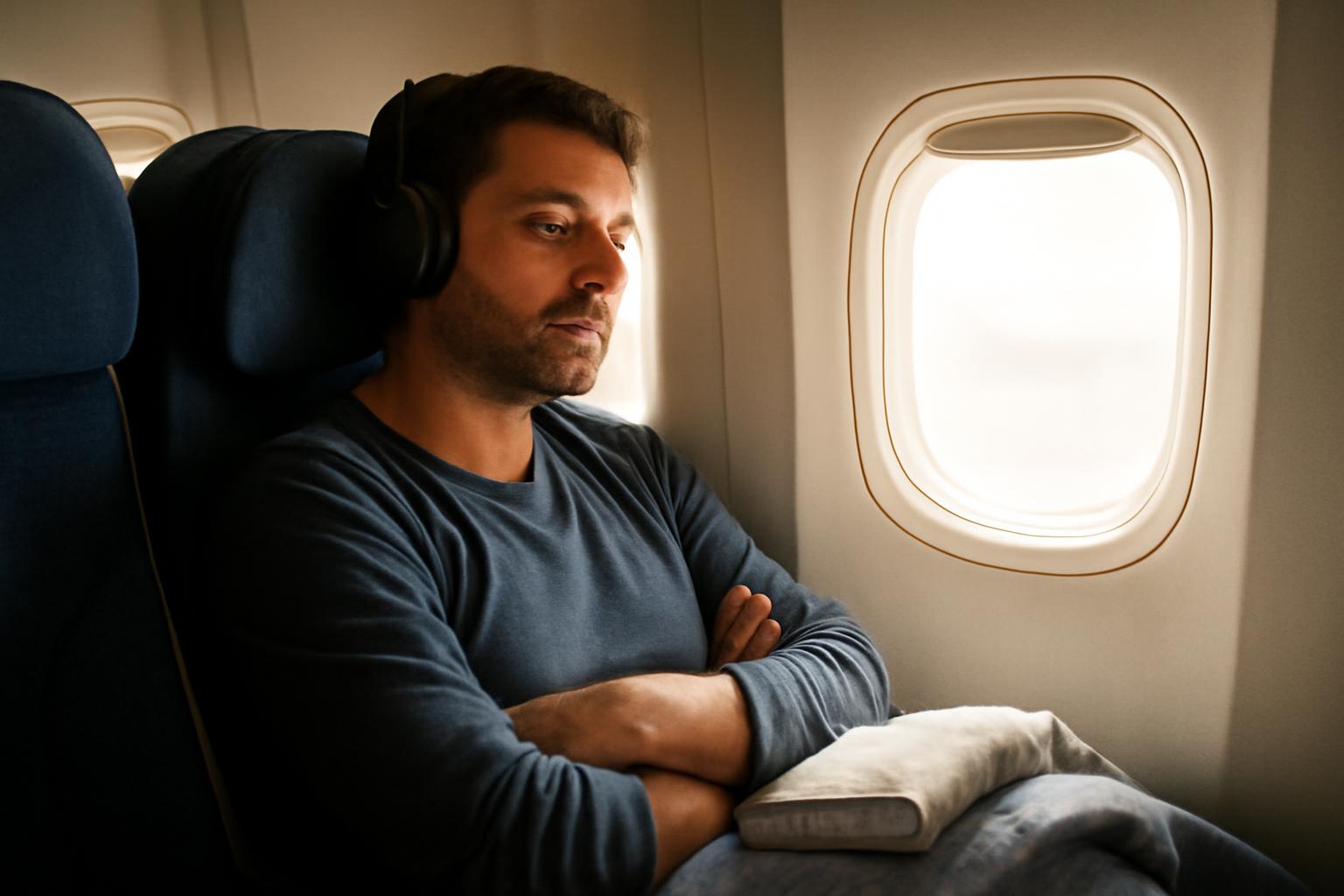
The easiest way to avoid boredom on a plane is to stop expecting one movie, one book, or one device to carry the whole journey. Instead, prepare a small menu of activities for different energy levels: something entertaining, something screen-free, one manageable task, and an option that requires almost no concentration.
That approach works for a short domestic hop, a daytime journey, or a long-haul overnight flight. It also gives you alternatives when Wi-Fi fails, your battery runs low, reading becomes uncomfortable, the tray table is occupied, or you simply lose interest in what you started.
Choose an activity that fits your flight and your mood
When you are bored on a plane, begin by asking what you want from the next stretch of time. Do you want to be entertained, make something, finish a task, connect with someone, rest, or simply let the minutes pass?
Use this quick chooser:
| Goal | Activities to try | Practical characteristics |
|---|---|---|
| Be entertained | Watch a movie or television episode; listen to music, a podcast, or an audiobook; read a book or magazine; play an offline game; solve a puzzle; follow the flight map | Screen-based or audio; usually solo; some options depend on a battery; most require little or no tray space |
| Make something | Journal, sketch, color, draft a letter, write a story, create lists, or design a simple itinerary | Mostly screen-free and battery-free; usually solo; paper activities may need a tray table |
| Get a task done | Review travel plans, shortlist attractions, organize photos, clean up downloaded files, study notes, or outline a project | Usually solo; may be digital or paper-based; concentration and workspace requirements vary |
| Connect with a companion | Talk quietly, solve a puzzle together, plan the destination, play a contained game, or synchronize a film | Shared; may be screen-free; should stay quiet and within your seating area |
| Rest | Close your eyes, listen to familiar audio, use an eye mask, or try to sleep | Requires no tray; may be battery-free; success depends heavily on personal comfort |
| Pass a low-energy stretch | Watch the window, check the flight map, revisit saved photos, listen to music, make a short list, or sit quietly | Low concentration; little or no surface needed; several options work without a battery |
There is no universally best activity. A film may suit a daytime flight when you feel alert but seem exhausting during an overnight journey. A novel may occupy one person for hours while another cannot concentrate on it in the cabin. On the outbound journey, destination planning may feel exciting; on the return, organizing photographs or recording memories may be more appealing.
Participants in a user-generated travel forum describe varied personal routines that include films, books, audio, games, reflection, sleep attempts, and permitted walks. Those examples are anecdotal rather than representative, but they illustrate why switching formats can be more practical than relying on one activity for an entire long flight (Rick Steves Travel Forum discussion).
Your seat matters too. A window passenger may prefer activities that remain accessible without getting up. Someone in an aisle seat may find it easier to put an activity away when leaving the seat is permitted. Concentration, motion sensitivity, time of day, available light, meal service, turbulence, and the behavior of nearby passengers can all change what feels practical.
Airline amenities also vary by carrier, aircraft, route, fare, and operating conditions. Do not build your entire plan around working Wi-Fi, a power outlet, a particular entertainment library, a meal, or even a functioning seatback screen. Treat those amenities as useful extras and concentrate on the options you can prepare yourself.
Prepare an offline flight kit before boarding
A good flight kit is less about carrying a large collection than eliminating single points of failure. If your only plan depends on streaming, power, or access to the overhead bin, a minor problem can leave you with nothing convenient to do.
Before leaving home:
- Charge your phone, tablet, e-reader, headphones, and any other devices you intend to use.
- Download your chosen entertainment rather than merely adding it to an online list.
- Put each device in airplane mode and open the downloads to confirm that they work.
- Check that games launch and remain playable without an internet connection.
- Pack the correct charging cables and adapters for your devices.
- Check available storage and review download-quality settings.
- Verify your operating carrier’s current rules for electronics, spare batteries, and power banks.
- Put immediate essentials in the bag that will remain under the seat.
Download a varied mix rather than one long queue of similar content. A sensible selection might include:
- One film or several television episodes
- A few short podcast episodes and at least one longer episode
- Familiar music and a new album or playlist
- Part of an audiobook
- An ebook
- One or two games that genuinely work offline
- Optional downloaded language lessons or saved destination material
Variety matters because attention changes. If a two-hour film seems unappealing after dinner, a short podcast may still work. If your eyes are tired, an audiobook provides another format without adding luggage. One commercial travel guide likewise advises downloading desired media before departure because onboard Wi-Fi or entertainment may be unavailable (Booking.com’s guide to passing time on a plane).
Do not assume that an outlet or USB port will be available, compatible, or working. Bring charging cables if your flight may provide power, but treat access as a possibility rather than a guarantee.
Power-bank rules require particular care because they can be airline-specific. For example, Qantas says permitted power banks may be carried under specified conditions but cannot be used or charged during its flights. That is a Qantas policy, not a universal rule, so check the current requirements of your own operating carrier before traveling (Qantas long-haul guidance and power-bank notice).
Keep these items in the under-seat bag if you expect to use them:
- Headphones
- Your primary device or e-reader
- Charging cables
- A physical book or puzzle
- A notebook and pen or pencil
- Travel documents
- Glasses and other immediate personal essentials
- Any permitted comfort items you want during the flight
This reduces repeated trips to the overhead bin and is particularly useful from a window seat. It also means you still have something to do while access to overhead storage is inconvenient or restricted.
Finally, pack a minimalist battery-free backup: one reading item, one notebook or paper puzzle, and one pen or pencil. That small combination covers reading, writing, drawing, list-making, paper games, and trip planning even if every screen and charging option fails.
Entertainment ideas for screens, audio, and quiet cabin time
Screens are an obvious place to begin, but you do not have to commit to a full film. Browse the seatback library if one is available, continue a television series, choose a documentary, play a quiet offline game, or follow the flight map. The map can be particularly useful during a low-energy period when you want visual interest without a complicated plot.
Downloaded media gives you more control and provides a backup when the onboard library does not suit you. Match the format to the time available:
- Short segment: One television episode, a short podcast, a simple game, or part of a documentary
- Longer block: A film, several connected episodes, or a substantial section of an audiobook
- Long-haul flight: Several formats that can be rotated, such as a film, music, a podcast, and an ebook
Audio is one of the most adaptable options because it requires no tray-table space and can be used with your eyes closed. Consider downloaded music, podcasts, audiobooks, language lessons, white noise, nature sounds, or other audio that you personally find relaxing. These are entertainment and comfort options, not treatments for anxiety, insomnia, or motion sickness.
Audio may work well when you are tired of screens, cannot concentrate on a book, or are waiting through a period when the tray table cannot be used. Familiar content can also be easier to follow than a complicated new story when you are fatigued.
Reading offers similar variety. You might bring:
- A novel
- A short-story collection
- A magazine or newspaper
- An ebook
- A comic or graphic novel
- A destination guidebook
- Printed articles saved for the trip
A physical book is battery-free but adds weight and takes up space. An e-reader can hold a larger library but depends on charge. Neither is inherently better; choose according to how much you expect to read and how much equipment you want to carry.
Whatever you choose, keep the cabin environment in mind. Use headphones for all sound, disable game noises, and reduce screen brightness during dark or quiet periods. Avoid raising your voice over your headphones. A stranger’s proximity does not create an obligation to talk, watch something together, or react to your entertainment.
Companions can synchronize a film or use a quiet shared-audio setup if their devices and accessories support it. Test the arrangement before the flight rather than assembling an awkward tangle of cables at the seat. Shared entertainment should not require loud sound, block the aisle, spill into another passenger’s space, or create unnecessary light during a quiet cabin period.
Screen-free, creative, and productive things to do
If another film sounds unbearable, switch formats completely. Compact screen-free activities include:
- Reading a book or magazine
- Solving a crossword, Sudoku, or word search
- Working through a puzzle book
- Playing solitaire
- Drawing or doodling
- Coloring
- Writing a journal entry
- Drafting a letter
- Making lists
- Playing hangman, dots and boxes, or another simple paper game
- Writing a short story or travel reflection
Choose quiet, low-mess supplies that remain inside your seating area. A pencil case, small notebook, and puzzle book are easier to manage than an elaborate craft kit. Loose cards can slide between seats, while dice and tiny pieces can disappear during turbulence. If you bring a compact game, favor one with contained, attached, or magnetic components.
Creative work does not need to be ambitious. You can sketch the wing, cloud formations, the view from the window, or an object on your tray. You might write a page about what you hope to do at the destination, draft a postcard, create a packing list for the return journey, or invent a short story from a prompt. The point is to choose an activity with enough structure that beginning feels easy.
Productive tasks that fit a plane seat
A flight can provide uninterrupted time, but it does not automatically provide good working conditions. Noise, fatigue, motion, limited elbow room, meal interruptions, and an unavailable tray can make intensive work unrealistic. Bounded tasks with a visible endpoint are often more manageable.
On an outbound flight, consider:
- Reviewing your itinerary
- Shortlisting attractions or restaurants from material saved offline
- Marking essential addresses and booking details
- Learning basic destination vocabulary
- Studying downloaded notes
- Creating a simple arrival checklist
- Outlining a project rather than trying to complete it
- Filling out travel forms when they are provided
On the return flight, try:
- Writing a journal entry
- Recording favorite moments before you forget them
- Beginning a trip report
- Drafting captions
- Making a list of places you would revisit
- Organizing photographs from the trip
Digital housekeeping can be done without Wi-Fi if the relevant files are stored on the device. Delete obvious duplicates, select favorites, add captions, organize one album, clear unneeded downloads, or remove unused files. Avoid turning the task into a complete digital overhaul. One folder or one day’s photographs is a more realistic target.
If you want a project with a clear finish line, choose one of these:
- Finish one puzzle.
- Write one journal page.
- Sketch the window view.
- Learn ten useful phrases.
- Organize one photo album.
Completing a small task can feel satisfying without creating pressure to make the flight “productive.” If concentration disappears, save the work and move to audio, a simple game, or rest.
Sample plans for two-hour, six-hour, and long-haul flights
These schedules are flexible examples, not scientifically optimized routines. Boarding, taxiing, meal service, turbulence, cabin lighting, and delays can all change the sequence.
A flight of around two hours
- Boarding and departure: Stow your belongings, keep loose supplies contained, and review the safety information.
- Main block: Watch one film if its running time fits, or listen to several podcast or television episodes.
- Backup block: Read a paper book, solve a puzzle, or listen to music.
- Final segment: Put items away and check your arrival details.
A short flight may not need much variety, but it still benefits from a battery-free backup. The entertainment system could be unavailable, or the usable cruise portion may be shorter than expected.
A flight of around six hours
- First block: Watch a film, read, or listen to a longer podcast.
- Meal or snack service: Choose an activity that does not need the tray, such as audio or the flight map.
- Short task: Write one journal page, review the itinerary, or organize one photo album.
- Change of format: Move from a screen to a book, puzzle, or audiobook.
- Movement: Leave the seat only when the seatbelt sign is off and crew instructions permit it (Booking.com’s in-flight activity guidance).
- Final block: Choose familiar music, a simple game, or a television episode before arrival.
This plan prevents any one activity from becoming tiring. If you become absorbed in a book or film, there is no need to stop merely because a schedule says so; the blocks are options, not obligations.
A flight of 12 hours or more
Think in broad phases instead of accounting for every hour:
- Settle in: Organize the items you need and browse your choices.
- First entertainment block: Watch a film or several episodes.
- Meal and low-space activity: Use audio, quiet conversation, or the flight map.
- Screen-free block: Read, journal, sketch, or solve puzzles.
- Small practical task: Review travel details, complete provided forms, or organize a limited group of files.
- Permitted movement and personal care: Wait until movement is allowed and keep your routine brief and considerate.
- Rest opportunity: Close your eyes or try to sleep if you want to.
- Second entertainment block: Switch to a different medium rather than repeating the first.
- Pre-arrival block: Pack loose items, check documents, and review a simple arrival list.
For a daytime flight, you may spend more of the journey on films, books, games, conversation, or practical tasks. On an overnight flight, reduce light and noise when the cabin settles, use eyes-closed audio, or create one or more opportunities to rest. This is an adaptation to the cabin period, not a promise that a particular sleep schedule will prevent jet lag.
The phase of flight should also shape your choice:
- During boarding: Keep activities compact because people are still stowing bags and taking seats.
- During meal service: Use no-tray options such as music, podcasts, or quiet conversation.
- During turbulence: Follow crew instructions and put away or secure devices, drinks, cards, and other loose objects. Flight conditions and crew directions can make otherwise practical activities temporarily unsuitable (Blogger at Large’s long-flight guide).
- Before arrival: Complete documents, organize your seat area, and review onward travel details.
Variation is useful for a simple reason: attention and comfort change. You may want a complicated story early in the flight, familiar audio after a meal, a small task later, and no entertainment at all when tired.
Fallback plans for no Wi-Fi, no power, or poor concentration
A contingency plan should cover more than a failed internet connection. Think separately about connectivity, battery power, screens, and concentration.
If there is no Wi-Fi
You can still use:
- Downloaded music, podcasts, or audiobooks
- Offline games tested in advance
- Ebooks stored on the device
- A physical book or magazine
- Paper puzzles
- A journal or sketchbook
- Saved itinerary notes
- Printed destination information
- Quiet conversation with a receptive companion
“No Wi-Fi” should be a minor inconvenience if the files you need are already on your device. Remember that saving a link or adding content to a queue does not necessarily make it available offline.
If the battery dies or the screen breaks
Switch to:
- Printed reading
- A notebook
- A puzzle book
- Window viewing
- A flight map on another functioning display, if available
- Quiet reflection
- Rest
- A compact battery-free game
- Paper games with a companion
This is where the minimalist backup earns its place. A notebook and pencil can become a journal, sketchbook, list pad, game surface, or trip planner.
If reading or screens feel uncomfortable
Some participants in a user-generated travel discussion report motion sickness, fatigue, poor concentration, or difficulty following books while flying. These are individual experiences rather than clinical evidence, and travelers’ responses differ considerably (Rick Steves Travel Forum discussion).
Do not force an activity merely because it usually works on the ground. Try:
- Eyes-closed audio
- Familiar music
- Quiet reflection
- Looking out the window when that feels comfortable
- Watching the flight map
- Closing your eyes without trying to sleep
- Resting with no entertainment at all
These are alternative ways to pass time, not treatments. If one format makes you feel worse, stop and try another.
For a low-energy period, listen to something familiar, review a few saved photographs, make a short list, or let the flight map run. You do not need to maximize every hour. Sometimes the most appropriate activity is simply sitting quietly.
Window-seat passengers can reduce disruption by keeping headphones, a book, a notebook, and essential documents within reach. Choose options that do not require repeated access to the overhead bin or frequent movement past seatmates. If discomfort or poor attention develops, switch early instead of struggling through a book, game, or work session.
Ideas for solo travelers, companions, and children
Solo travelers have the widest control over pace. Reading, downloaded media, puzzles, journaling, photo organization, itinerary planning, sketching, and offline work do not depend on anyone else’s interest. Alternate between absorbing and undemanding options so you are not left with only complex activities when tired.
Companions can:
- Watch the same downloaded content quietly
- Solve a crossword together
- Play a contained travel game
- Plan a day at the destination
- Exchange drawing or writing prompts
- Make a shared list
- Talk when both people want to engage
Do not let a shared activity spread across another passenger’s tray, armrest, or legroom. If you play a game, choose one without audible alerts and keep every component contained.
Conversation with an unfamiliar seatmate should depend on clear mutual interest. A brief greeting can reveal whether someone is receptive, but headphones, short answers, closed eyes, or attention directed toward a book are reasonable indications that the person prefers privacy. End the exchange gracefully rather than treating proximity as an invitation to continue.
Compact activities for elementary-aged children
A small rotation can include:
- Plain paper and pencils
- A compact set of drawing supplies
- An activity or puzzle book
- An LCD drawing tablet
- A maze, hidden-picture, or word-search book
- A magnetic or otherwise self-contained game
- One handheld puzzle
- Pre-downloaded screen content
- A familiar book
Favor supplies that are quiet, low-mess, and easy to repack. Tiny pieces and loose cards can fall under seats. If a child can developmentally manage their own activities, involve them in choosing, changing, cleaning up, and repacking each item.
The available child-specific evidence is limited. One detailed travel guide bases its suggestions largely on one family’s experience with children around ages eight and ten, including paper, drawing tablets, puzzles, and magnetic games. That experience should not be generalized to every child, age, attention span, or developmental need (Familee Travel’s elementary-age airplane activity guide).
Do not expect any toy, book, or video to occupy a child for a predictable length of time. It is usually more practical to rotate a few compact choices than to rely on one “perfect” activity. Screen use is a family decision; one family’s approach should not be presented as health or developmental guidance.
The available evidence is not sufficient for detailed recommendations tailored to toddlers, teenagers, neurodivergent travelers, or passengers with specific sensory or mobility needs. Those travelers may require substantially different preparation based on individual preferences, communication needs, available support, and the trip itself.
Make room for rest, movement, and considerate cabin behavior
Rest is one possible activity, not the required centerpiece of every flight. Some passengers sleep easily on planes; others cannot sleep despite being tired. Closing your eyes, listening to quiet audio, or sitting without a task can still provide a low-demand break even when sleep does not happen.
Comfortable layers, an eye mask, a pillow, or headphones may make the environment more manageable for some people. They are personal options, not proven necessities, and you do not need to purchase specialized products to rest.
Avoid treating a general activity guide as a prescription for nap length, destination-timed sleep, caffeine use, medication, compression socks, hydration targets, or movement intervals. Those questions depend on evidence and personal circumstances beyond the scope of boredom planning.
If you want to leave your seat, wait until the seatbelt sign and crew instructions permit it. Consider available space, service carts, other passengers, and your own mobility. Crew instructions take priority over a general suggestion to walk, stretch, retrieve supplies, use a device, or continue an activity.
Keep these etiquette boundaries in mind:
- Use headphones and turn off all game sounds.
- Contain cards, craft materials, and drawing supplies.
- Avoid foods, products, or activities with strong odors.
- Keep your belongings within your assigned space.
- Respect passengers who do not want to talk.
- Put loose items away when instructed.
- Keep personal-care routines brief in shared cabin areas.
- Be mindful before reclining when the passenger behind is eating or using the tray, a courtesy also recommended by etiquette coach Mariah Grumet (Business Insider’s airplane-etiquette interview).
Current crew instructions and operating-carrier or airport-security rules override general advice about electronics, batteries, food, liquids, craft supplies, movement, and seat use. Check restrictions before packing anything unusual, and stop or put away an activity whenever instructed. Travel activities and supplies remain subject to changing flight conditions and applicable rules (Blogger at Large’s discussion of long-flight activities and restrictions).
NapHelp’s content is informational rather than medical advice. Anyone with a sleep disorder, excessive daytime sleepiness, mobility limitation, or another health concern should seek guidance from an appropriate qualified professional instead of relying on a general list of flight activities (NapHelp’s informational and medical boundary).
Frequently asked questions
What should I download before a flight?
Download a varied offline mix: one film or several television episodes, short and long podcast episodes, music, part of an audiobook, an ebook, and one or two offline games. You can also save language lessons, destination notes, booking details, maps, or articles.
Charge your devices, check available storage, and test every item in airplane mode before leaving home. Confirm that games launch without a connection. Pack the relevant cables, but do not assume that onboard power will be available or working.
What can I do on a plane without Wi-Fi or a working screen?
Read a physical book or magazine, solve paper puzzles, journal, sketch, write a letter, make lists, plan your itinerary from printed notes, play a compact battery-free game, watch the view, rest, or talk quietly with a receptive companion.
A notebook and pencil are especially useful because they support writing, drawing, trip planning, and simple paper games without requiring power, connectivity, or much space.
What are quiet, screen-free activities for a plane?
Good options include reading, crosswords, Sudoku, word searches, puzzle books, journaling, drawing, coloring, letter writing, list-making, itinerary planning, and simple paper games. Choose low-mess materials with few loose pieces, and keep everything within your seating area.
If you bring cards or a travel game, use a compact version that is easy to contain. Be prepared to put it away whenever flight conditions or crew instructions require loose items to be secured.
What can I do if reading or watching a screen makes me uncomfortable?
Stop rather than forcing the activity. Try downloaded music, a podcast, an audiobook, familiar audio, quiet reflection, the flight map, window viewing when comfortable, or resting with your eyes closed.
These are alternative activities, not medical treatments. Choose according to your comfort and discontinue anything that makes you feel worse.
What can children do on a plane without packing many toys?
Pack a small rotation: plain paper and pencils, one activity or puzzle book, an LCD drawing tablet, one contained game or handheld puzzle, and optional pre-downloaded screen content. Familiar books, word games, and parent-child drawing prompts can add variety without requiring many separate toys.
Avoid materials with numerous tiny pieces unless the child can reliably manage and repack them. No activity is guaranteed to hold attention for a set period, so choose a few compact options that can be rotated according to the child’s age, interests, and energy.
A simple plan for your next flight
The simplest preparation rule is this: download one or two forms of entertainment, pack one battery-free activity, choose one small task, and keep one low-energy option available.
Rotate when your attention or comfort changes rather than forcing a particular book, film, task, or sleep attempt. Cabin conditions, crew instructions, current airline rules, personal comfort, and consideration for nearby passengers are the final constraints.