
Feature
Red Light Therapy Light Bulbs: Types, Specifications, Evidence, and Safety
Petra Halloran · · 13 min
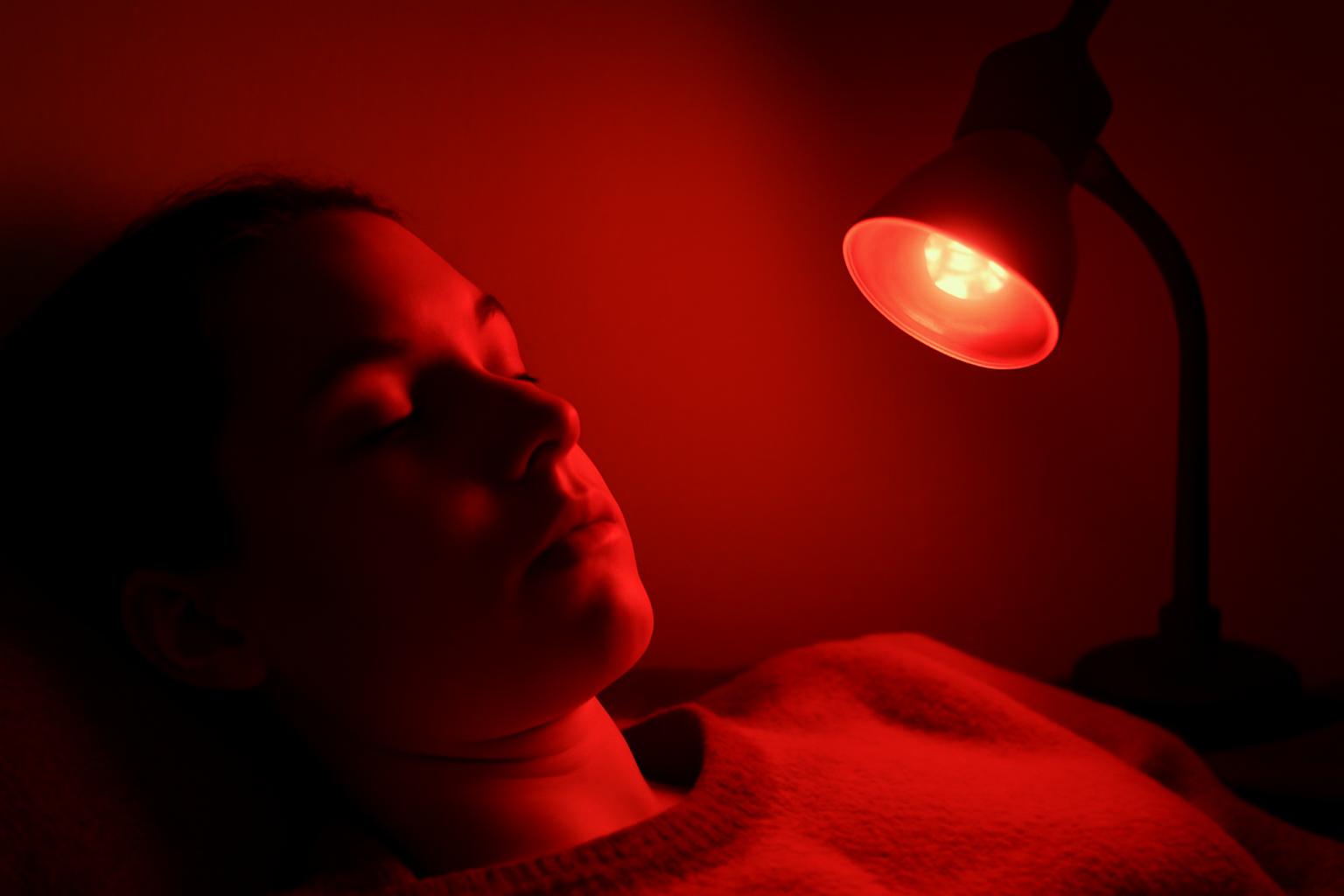
Overview
Red light therapy light bulbs are not interchangeable with red sleep bulbs, heat lamps, or tanning-bed tubes. A credible choice depends on the product’s intended use, wavelengths, irradiance at a stated distance, coverage, electrical and mechanical compatibility, evidence quality, and device-specific exposure and safety instructions.
The first decision is therefore classification, not brand or electrical wattage. A screw-in bulb marketed for photobiomodulation should provide more than a red appearance. Its listing should identify the emitted spectrum and explain how output was measured. It should also provide enough information to determine whether the beam covers the intended area and whether the bulb can be mounted safely.
Seller specifications are useful for screening products, but they are not independent verification. A claimed wavelength or irradiance measurement does not establish that the device produces a clinically useful result. Likewise, research involving controlled red or near-infrared photobiomodulation cannot automatically validate an untested consumer bulb.
The main types of red and infrared light bulbs
Classify a product by its intended function and output, not by the fact that it looks red. The supplied listings show several distinct categories using similar language, even though their equipment requirements and intended uses differ.
| Product type | Intended use | Output and equipment clues | Main classification check |
|---|---|---|---|
| Targeted LED therapy bulb | Localized red or near-infrared exposure | The Wolezek listing describes 9 red LEDs at 660 nm and 9 near-infrared LEDs at 850 nm in an E26/E27 screw-in bulb | Look for wavelength-specific output, irradiance at stated distances, beam angle, and treatment instructions |
| Incandescent red/infrared therapy bulb | Broad-spectrum light with substantial warmth | Chromalux describes a tuned incandescent filament emitting from 680 to 1400 nm in an E26 R30 flood bulb | Confirm that the seller identifies the spectrum and heat precautions, rather than merely describing red-colored glass |
| Circadian red bulb | Reduced blue-light exposure in bedrooms or relaxation spaces | Bon Charge describes its 630 nm bulb as a sleep-oriented red light that is not suitable for general illumination | Do not assume a circadian lamp has measured therapeutic irradiance or therapy-specific instructions |
| Heat-producing red or infrared lamp | Radiant warmth, sometimes marketed alongside therapy applications | HealthLighting states that its incandescent red/infrared bulb becomes hot during use | Treat heat output as a thermal and fixture issue, not as proof of a photobiomodulation dose |
| Tanning-bed replacement tube | Installation in compatible professional tanning equipment | Ultraviolet Resources describes its products as bulbs for professional tanning beds and publishes equipment-specific contraindications | Do not treat a tanning tube as a household screw-in therapy bulb |
These categories can overlap in appearance. An incandescent therapy lamp produces heat, while an LED therapy bulb may produce much less perceptible warmth. A sleep-oriented bulb can emit a specific red wavelength without supplying the measured output information expected for targeted exposure.
Equipment context is particularly important. The Ultraviolet Resources products belong in tanning systems, not ordinary household sockets. Its published contraindications, including restrictions involving people under 18 and people with skin lesions or open wounds, are product-specific and should not be transferred to unrelated bulbs. Conversely, their presence shows why a generic search for “red light bulbs” is too broad to establish suitability.
Visible red, near-infrared, LED, and incandescent output
Wavelength describes where light falls within the electromagnetic spectrum. It does not, by itself, establish treatment quality. The supplied products illustrate three different approaches: a 630 nm visible-red circadian bulb, a dual-wavelength 660 nm and 850 nm LED therapy bulb, and an incandescent bulb with a claimed 680 to 1400 nm emission range.
Visible red and near-infrared should not be judged by appearance alone. Wolezek explains that 850 nm output is invisible to the human eye, so only the 660 nm chips appear illuminated when its dual-wavelength bulb operates. A dark-looking 850 nm emitter is therefore not necessarily inactive. Its output must be checked through credible measurement rather than visual brightness.
Heat is equally unreliable as an optical test. HealthLighting warns that its incandescent red/infrared bulb becomes hot. That is a characteristic of its technology and operating conditions, not evidence that a particular amount of near-infrared energy reaches the skin. An LED can emit invisible near-infrared without producing the same sensation of heat, while a hot lamp does not establish a useful photobiomodulation dose.
The Hale Health photobiomodulation dose table describes red wavelengths as acting more superficially and near-infrared wavelengths as reaching deeper muscle, joint, and nerve targets. That general distinction can help a buyer understand why combination bulbs exist, but it does not prove that 850 nm is better than 660 nm for a particular condition or that combining the two improves outcomes.
LED and incandescent listings also describe spectrum differently. A dual-wavelength LED concentrates output around selected bands. Chromalux markets a tuned incandescent filament with a broader 680 to 1400 nm spectrum. The supplied evidence does not include a controlled comparison showing that a continuous spectrum produces better outcomes than selected wavelengths.
The same limit applies to wavelength count. More listed wavelengths may broaden a device’s output, but the number alone is not clinical evidence. The relevant questions are whether the wavelengths match a studied application, whether the device’s delivered output is known, and whether the exposure is comparable to the investigated protocol.
What the clinical evidence does and does not establish
The supplied clinical evidence supports a narrow conclusion: controlled low-intensity red or near-infrared photobiomodulation may affect pain and function in tendinopathy, but the evidence does not validate consumer screw-in bulbs as a category.
A 2021 systematic review and meta-analysis included 17 randomized controlled trials involving 835 participants with tendinopathy or related disorders. Eligible randomized trials used red or near-infrared photobiomodulation and compared it with sham treatment or another intervention.
The review found that photobiomodulation produced similar changes in pain when compared only with other interventions. Its reported mean difference was -0.09, with a 95% confidence interval from -0.79 to 0.61. Function improved less in that comparison, with a standardized mean difference of -0.52 and a 95% confidence interval from -0.81 to -0.23.
Results differed when exercise was part of the comparison. Photobiomodulation plus exercise produced a greater reduction in pain than sham treatment plus exercise, with a mean difference of 1.06 and a 95% confidence interval from 0.57 to 1.55. It also produced a reported functional improvement of 5.65, with a 95% confidence interval from 0.25 to 11.04. When photobiomodulation plus exercise was compared with other interventions plus exercise, however, the review found no difference in pain.
The authors classified the outcome evidence as very low to moderate quality. That qualification matters. The trials used controlled devices, treatment sites, doses, and comparison conditions. These controlled devices and protocols should not be assumed equivalent to a consumer bulb. A buyer cannot assume that a household bulb reproduces those exposures merely because its listing mentions similar wavelengths.
The evidence also remains condition-specific. This review cannot establish that a screw-in bulb improves skin appearance, hair growth, wound healing, general inflammation, nonspecific pain, or exercise recovery. Seller statements and customer testimonials about soreness or recovery are not substitutes for controlled product-specific trials.
A therapy bulb may deliver light in a wavelength range used by researchers while still differing in irradiance, beam geometry, distance, exposure time, and treatment area. Clinical plausibility, product output, and demonstrated clinical effectiveness are three separate questions. A responsible buying decision keeps them separate.
Specifications to verify before buying
The most useful red light therapy bulb specifications explain what reaches the target, where it reaches, and whether the bulb can be operated safely. Electrical wattage alone answers none of those questions. It primarily describes power use, not delivered optical exposure.
A listing should provide enough information to check the following:
- Spectrum evidence: Look for identified wavelengths or a spectral range and ask how they were measured. Wolezek claims 660 nm and 850 nm output, while Chromalux claims a 680 to 1400 nm range. These remain seller-reported specifications unless supported by independent testing.
- Irradiance at distance: Require values in mW/cm² at named distances, along with the measurement method and location within the beam. Wolezek reports 141 mW/cm² at the bulb face, 123 mW/cm² at 3 inches, and 98 mW/cm² at 6 inches.
- Beam and treatment area: Wolezek lists a 60-degree beam angle, but a beam angle alone does not show whether irradiance is uniform across the illuminated area. Ask for a coverage map or multiple measurement points.
- Socket, voltage, and dimensions: Wolezek specifies E26/E27 compatibility and 100 to 240 V AC. Chromalux specifies an E26 base and an R30 bulb measuring 5.25 inches long by 3.75 inches in diameter. Match every field to the fixture and local supply.
- Weight and mounting load: Wolezek lists a weight of 1.2 pounds and advises using a floor lamp rather than a flexible gooseneck clamp. Confirm that the fixture can hold the bulb at the required angle without sagging or tipping.
- Accessories, warranty, and support: Determine whether a socket, holder, stand, timer, or protective eyewear is included. Wolezek states that its listing includes only the bulb, not a light socket. Verify warranty terms and the process for addressing output or mechanical failure.
Specification consistency is also evidence. Customer-review summaries report mixed durability, including alleged failures after 15 to 20 uses and broken bases. Those reports are anecdotal and cannot establish a failure rate, but the combination of contradictory listing data and reported early failures is a reason to request written clarification.
Independent verification would ideally cover the spectrum, irradiance at several distances and beam positions, electrical safety information, and long-term output stability. The supplied corpus does not provide independent laboratory verification for these products. When only seller measurements are available, the honest conclusion is that the claimed performance remains unconfirmed.
Bulb versus panel: choosing the right form factor
A bulb is most practical when the intended exposure area is limited and the user has a stable, compatible fixture. Its screw-in format can be portable, but it may require a separate holder, manual positioning, and repeated adjustment to maintain the stated distance and angle.
A panel can simplify coverage of a larger area. In a BudgetLightForum discussion, one user described a linked panel as more convenient because it covered more area and included a 20-minute timer, while smaller light sources required frequent repositioning. That is an individual observation, not a controlled comparison, but it identifies real form-factor questions: coverage, positioning effort, and built-in controls.
Neither format is universally superior. A directional bulb may suit one knee, shoulder, or other small target if its beam and output are adequately documented. A panel may be easier when consistent positioning across a broader region matters. Masks and other body-specific formats introduce different fit and coverage constraints that the supplied evidence does not compare.
Price also cannot be ranked reliably from this corpus. A bulb may appear less expensive while still requiring a rated stand, reflector, timer, or protective equipment. The relevant comparison is the complete usable setup, not the lamp price in isolation. Clinical outcomes cannot be inferred from size, convenience, or price.
Using a therapy bulb: dose, positioning, and safety
A therapy bulb’s instructions must be interpreted as a connected system. Distance changes irradiance and coverage. Time changes accumulated exposure. Position changes which tissue is illuminated. Technology affects heat, while the fixture determines whether the selected position can be maintained securely.
The supplied sellers give substantially different schedules. Wolezek suggests a distance of 0 to 30 cm and sessions of 10 to 25 minutes, depending on distance. HealthLighting recommends 10-minute increments at 16 to 24 inches and exposure on bare skin. These schedules are tied to different products and cannot be exchanged without comparable output measurements.
Frequency is another missing variable. The supplied evidence does not establish a universal daily or weekly schedule for consumer bulbs. Follow the instructions for the specific device only after confirming that the listing identifies irradiance, distance, exposure limits, heat precautions, and intended treatment area.
Relating irradiance, distance, and exposure time
Irradiance is optical power delivered to a unit of area, commonly expressed as milliwatts per square centimetre. Fluence, often called dose, is the accumulated energy per unit area over time. The Hale Health table gives the calculation:
Dose (J/cm²) = irradiance (mW/cm²) × time (seconds) ÷ 1,000
This equation explains why a minute value alone is incomplete. Ten minutes with a low-irradiance device does not deliver the same surface dose as ten minutes at a much higher measured irradiance. Distance matters because irradiance usually changes as the target moves away from the source, while beam geometry determines how that energy is distributed.
Wolezek reports an irradiance of 98 mW/cm² at 6 inches. If that claimed irradiance were received continuously and uniformly for 10 minutes, the surface calculation would be 98 × 600 ÷ 1,000 = 58.8 J/cm². That result is derived from the seller’s claimed measurement, not a verified clinical recommendation.
The calculation also does not establish how much energy reaches deeper tissue. It assumes the listed irradiance applies at the relevant point and remains stable for the whole session. It does not account for variation across the beam, reflection, tissue absorption, pulsing, measurement accuracy, or changes in distance and angle.
The Hale Health source discusses a biphasic dose response, meaning that more exposure is not automatically better. It summarizes effective doses for many conditions as falling between 4 and 30 J/cm² and reports that doses above roughly 60 J/cm² have sometimes been associated with reduced or reversed effects. Those broad ranges combine unlike applications and protocols, so they should not be converted into a universal target for a home bulb.
The tendinopathy review provides a useful illustration of this specificity. The tendinopathy evidence concerns specific controlled protocols, not a general schedule for consumer bulbs. That is evidence about the reviewed protocols, not a schedule for a 660 nm/850 nm consumer bulb. A useful product listing should allow dose calculation, but a condition-specific target still requires relevant evidence and device-specific guidance.
Eye exposure and protective measures
The supplied evidence supports general reassurance about many surface-emitting LEDs, but it does not certify every therapy bulb or every viewing duration. Optical design, radiance, wavelength, distance, exposure time, and foreseeable viewing conditions remain relevant.
An ICNIRP statement on LEDs concluded that most LEDs, particularly surface-emitting LEDs, pose no clear eye hazard under reasonably foreseeable use. It reported retinal exposure below 1% of known injury levels at a viewing distance of 10 cm and below 0.1% at typical distances of 0.5 to 2 metres. Its conclusion applied to visible and infrared surface emitters viewed for 100 seconds or less under the evaluated conditions.
That assessment should not be read as blanket approval to stare into a therapy bulb. A complete safety evaluation uses the source’s radiance and exposure conditions, not merely its electrical wattage or wavelength label. The ICNIRP document recommends evaluating LEDs under guidance for incoherent optical sources.
Seller instructions can be more restrictive. Chromalux says never to look directly at its incandescent bulb and advises protective eyewear, with closed eyes, when it is used on or near the face. HealthLighting similarly warns that its bulb is very bright and recommends protective eyewear for near-face use.
These instructions do not establish a universal rule for every red or near-infrared device. They show why buyers should obtain the specific product’s optical safety classification, exposure limits, and near-face directions. Invisible 850 nm output also cannot trigger a normal brightness-based avoidance response, so visible comfort is not an adequate safety test.
Heat, electrical compatibility, and stable mounting
A safe setup must satisfy electrical, thermal, and mechanical requirements at the same time. A bulb that fits the socket thread can still be unsuitable if its voltage, size, heat output, weight, or orientation exceeds what the fixture can support.
Before operating the bulb:
- Confirm the exact socket, supply voltage, bulb dimensions, and permitted electrical load against the fixture documentation.
- Check the fixture’s heat rating, especially for an incandescent lamp that the seller says becomes hot.
- Verify that the holder supports the bulb’s weight at the required angle without bending, loosening, or tipping.
- Keep the bulb at the product’s stated distance without relying on an unstable arm or improvised support.
- Determine whether the holder, reflector, timer, and protective equipment are included or must be obtained separately.
The Wolezek listing illustrates the mounting issue. It describes the bulb as weighing 1.2 pounds and recommends a floor lamp rather than a clamp lamp with a gooseneck arm. That warning applies directly to the listed bulb, but the underlying check is useful for any heavy directional lamp: the fixture must maintain position under the bulb’s actual load.
Incandescent products add a thermal constraint. HealthLighting explicitly warns that its red/infrared bulb gets hot, while Chromalux supplies near-face eye precautions. A suitable fixture therefore needs more than the correct E26 connection. Its enclosure, reflector, nearby materials, and adjustment points must remain compatible with the bulb’s operating heat and dimensions.
Setup quality also affects dose interpretation. If a flexible holder sags, the distance and beam angle change during the session, invalidating calculations based on a fixed irradiance. The right red light therapy bulb is consequently not just the emitter. It is a documented bulb, a compatible and stable fixture, and a device-specific exposure plan whose output and safety assumptions can be checked.