
6 min read ·
Sleep Elevated After Wisdom Teeth to Protect Clots
Before bed, get active bleeding under control and remove gauze unless your surgical team specifically says otherwise. Use only medicines they approved.
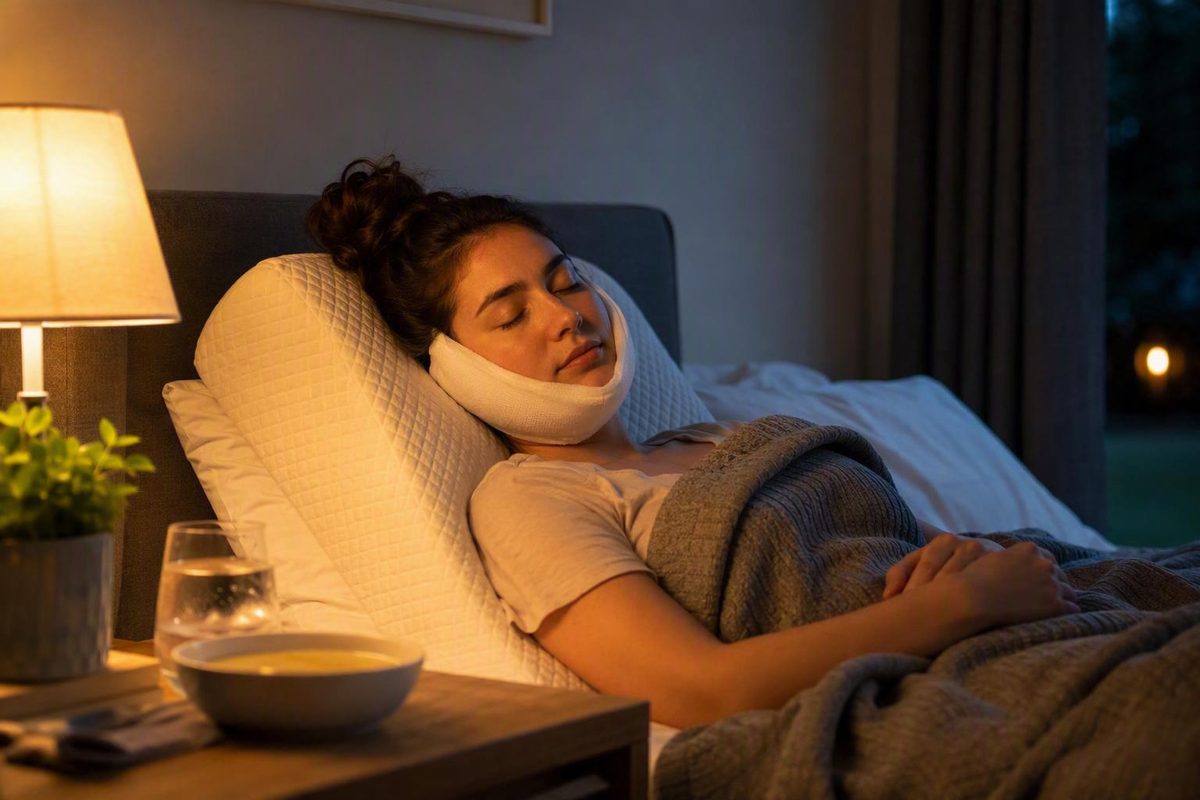
The safest way to sleep after wisdom teeth removal is to follow your oral surgeon’s discharge instructions, rest with your head elevated rather than lying flat, and protect the blood clot at each extraction site. Before bed, make sure active bleeding is under control, remove gauze unless your own surgical team specifically told you otherwise, and take only the medicines they approved, exactly as directed.
There is no single sleep position or recovery timeline that is right for everyone. The number of teeth removed, the difficulty of the procedure, the type of anesthesia, your health history, and your surgeon’s technique can all change the instructions. Treat this guide as general preparation, not a replacement for the plan you were given.
Set up your sleep space before you lie down
The first night is easier when you do not have to keep getting up or rearranging pillows while you are tired or numb.
- Build stable elevation. Use a recliner, wedge, or firm pillows that support your upper back and head without sharply bending your neck. Emory Healthcare’s wisdom-teeth aftercare guidance recommends resting with the head elevated rather than flat.
- Choose stability over a perfect angle. Your upper body should feel securely supported. If stacked pillows slide or make you curl forward, a recliner or wedge may be easier.
- Protect the bedding. A clean towel over the pillow can catch drool or a small amount of blood-tinged saliva. It also lets you see whether oozing is increasing.
- Keep essentials within reach. Have water, approved medicine, your written aftercare instructions, and the surgeon’s contact number nearby. Do not drink through a straw.
- Reduce fall risks. Clear the path to the bathroom and use a night-light, especially if anesthesia or prescribed medicine has made you sleepy or unsteady.
If you had sedation or general anesthesia, follow the supervision and activity restrictions on your discharge sheet. Do not drive, cook, use machinery, or make important decisions until your care team says those activities are safe.
Pick a position that protects your face and stays elevated
Start in the elevated position your surgical team recommended. For many people, that means reclining on the back with the shoulders and head supported. If that is uncomfortable, ask whether a supported side position is acceptable. Avoid pressing the operated side of your face into the pillow, and do not choose a position that makes you slide flat during the night.
Elevation is intended to help with swelling and discomfort; it is not a guarantee that swelling will not occur. Swelling, soreness, jaw stiffness, and bruising can be part of normal recovery. The NHS wisdom-tooth recovery guidance notes that pain and swelling should generally begin improving after the first day or two, though individual recovery varies.
How long should you sleep elevated? Instructions vary. Continue for the period your surgeon specified, and contact the office if you cannot find a tolerable position. Do not substitute a universal “three-night” or “five-night” rule for procedure-specific advice.
Protect the blood clot before bedtime
A blood clot forms over the socket and supports early healing. If it does not form properly or is dislodged, dry socket can develop. The American Association of Oral and Maxillofacial Surgeons advises protecting the surgical site, avoiding straws, and following the oral-hygiene directions from your surgeon.
Before going to sleep:
- Check the bleeding. A little blood mixed with saliva can look dramatic, but ongoing or heavy bleeding needs attention. Apply pressure only in the way your care team instructed. If bleeding will not stop, contact the surgical team or seek urgent dental help.
- Remove loose gauze. Do not fall asleep with gauze in your mouth unless your surgeon has given a specific, supervised instruction. The University of Illinois Chicago oral-surgery guidance says to remove gauze while eating and sleeping.
- Avoid suction and forceful mouth movements. Do not use a straw, smoke or vape, spit forcefully, or rinse vigorously. These actions can disturb the healing site.
- Leave the socket alone. Do not probe it with your tongue, finger, toothbrush, or any object. Follow the exact brushing and rinsing schedule on your discharge instructions.
- Skip alcohol and smoking. Both can interfere with safe recovery, and alcohol can interact with medicines. Follow your surgeon’s timeframe rather than assuming a short wait is enough.
If your own instructions differ—for example, on when to begin gentle salt-water rinses—use those instructions. Aftercare timing can depend on the procedure.
Use pain medicine safely at night
Take only medicine that your dentist, oral surgeon, physician, or pharmacist has confirmed is appropriate for you. Follow the label and the prescribed schedule; do not take an extra dose simply because you are worried about waking up in pain.
The American Dental Association’s acute dental pain guideline discusses non-opioid medicines as first-line options for many adolescents and adults after tooth extraction. That does not mean every over-the-counter product is safe for every person. Age, pregnancy, allergies, kidney or liver disease, ulcers, bleeding risk, and interactions with other medicines can change what is appropriate.
Check combination products carefully so you do not accidentally take the same active ingredient twice. If you are unsure what is in a prescription or cold-and-flu product, ask a pharmacist before combining it with anything else. Never use someone else’s prescription, and never mix alcohol with sedating pain medicine.
If a prescribed medicine makes you unusually hard to wake, causes severe confusion, or affects breathing, seek emergency help.
A simple first-night routine
Use your discharge sheet as the checklist and adapt this sequence to it:
- Eat and drink only what your care team allows, without a straw.
- Take approved medicine exactly as directed.
- Use a wrapped cold pack only if instructed; protect the skin and follow the timing your team provided.
- Confirm that bleeding is controlled and remove gauze before sleep unless specifically instructed otherwise.
- Settle into a stable, elevated position without pressure on the surgical area.
- Keep the surgeon’s instructions and contact number nearby.
- Rest. Avoid repeated checking, poking, rinsing, or “testing” the socket.
If you wake during the night, sit up slowly. Reassess how you feel, look for more than minor oozing, and follow the written plan for medicine, fluids, and gauze. Do not improvise a new treatment because you are tired or uncomfortable.
When to call the surgeon or get urgent help
Contact your dentist or oral surgeon promptly if something feels outside the recovery pattern they described. The NHS advises urgent dental help for bleeding that does not stop; severe or worsening pain and swelling that pain medicine is not helping; or pain accompanied by a bad taste, fever, or feeling unwell.
Also call for new or worsening symptoms that concern you, including persistent vomiting that prevents fluids or medicine, a rash after medication, or numbness that does not match the expectations on your discharge sheet.
Seek emergency help now for trouble breathing, severe difficulty swallowing, collapse, blue or gray lips, rapidly spreading swelling, or another life-threatening reaction. Do not wait until morning or rely on a sleep-position change for these symptoms.
The bottom line
For the first night after wisdom teeth removal, prioritize your surgeon’s instructions: control bleeding before bed, remove gauze unless specifically told otherwise, keep your head comfortably elevated, avoid pressure and suction around the sockets, and use medication only as directed. Prepare the room before you are tired, keep the surgical team’s number close, and escalate bleeding, worsening pain or swelling, fever, bad taste with illness, or breathing and swallowing problems instead of trying to sleep through them.