
Indica Has the Sleepier Reputation—but the Label Is a Weak Predictor
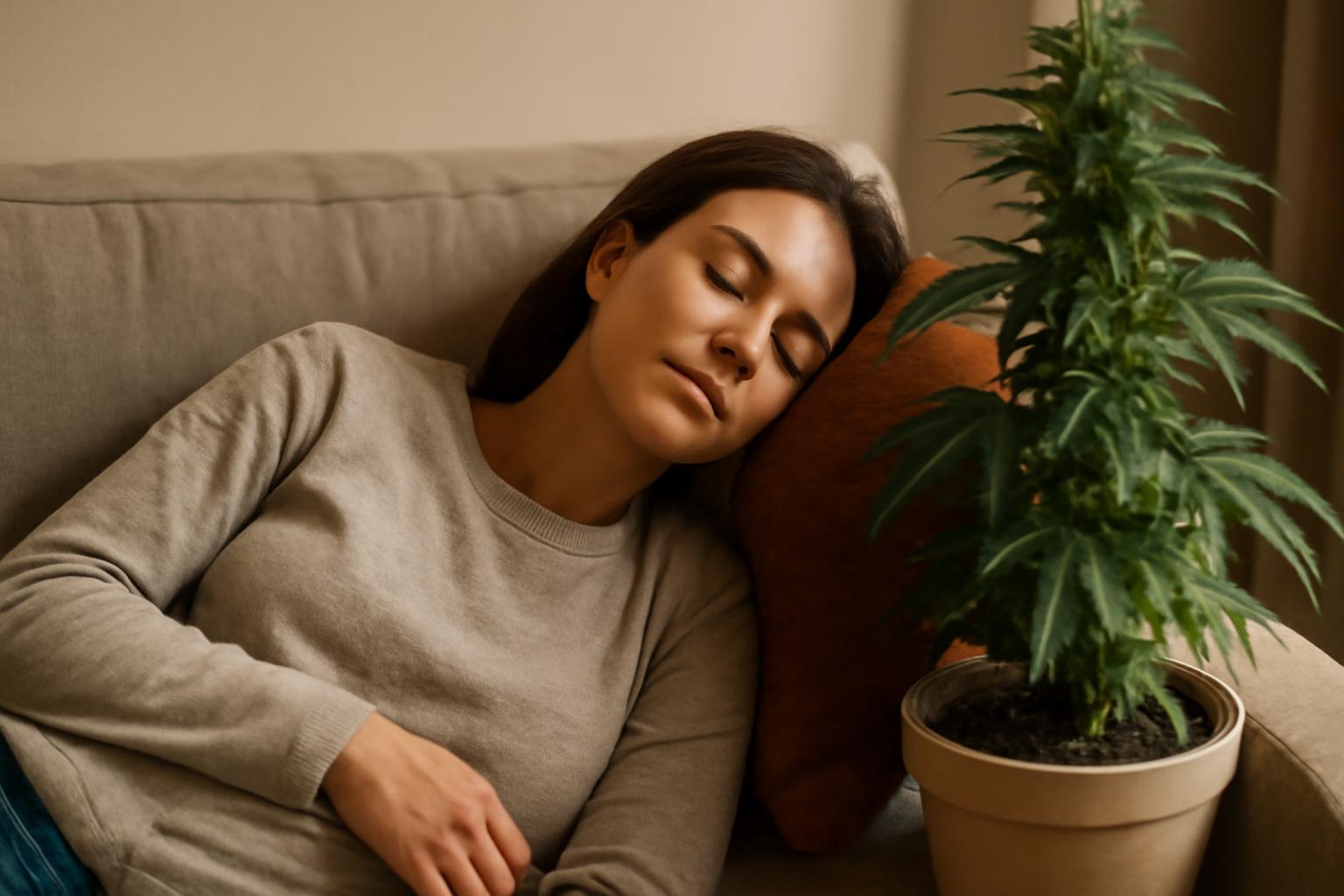
The short answer: indica is more associated with sleepiness
Indica has the sleepier reputation, but neither indica nor sativa reliably predicts how a particular product will affect a particular person.
The traditional shorthand is:
- Indica: relaxing, sedating, mellow, or better suited to nighttime.
- Sativa: stimulating, uplifting, energizing, or better suited to daytime.
These are common associations, not guaranteed pharmacological effects. Products with the same label can have different chemical profiles, and individual reactions vary. A sativa-labeled product can cause fatigue, while an indica-labeled product may feel stimulating or cause no noticeable sleepiness (Healthline’s comparison of indica, sativa, and hybrid cannabis).
| Label | Traditional association | What it does not guarantee | Factors that may matter more |
|---|---|---|---|
| Indica | Relaxation, sedation, nighttime use | Sleepiness, faster sleep onset, better sleep, or insomnia relief | THC and CBD content, potency, serving size, terpenes, formulation, tolerance, and individual response |
| Sativa | Energy, alertness, daytime use | Stimulation, wakefulness, or freedom from fatigue | THC and CBD content, potency, serving size, terpenes, formulation, tolerance, and individual response |
| Hybrid | A mixture of indica- and sativa-associated traits | A predictable balance of sedation and stimulation | The product’s actual chemical profile and the individual’s response |
The distinction is therefore best treated as a rough cultural and commercial shorthand. It cannot tell someone with confidence whether a product will make them sleepy, restless, anxious, relaxed, or impaired.
“More associated with sleepiness” also does not mean “proven to improve sleep.” Feeling drowsy is an immediate subjective effect. Treating insomnia, maintaining sleep, obtaining restorative sleep, and functioning well the next day are separate outcomes.
Why indica and sativa labels are poor predictors
Indica and sativa are broad cannabis classifications, not standardized descriptions of active chemical contents. They may indicate how a plant has traditionally been categorized or how a product is marketed, but they do not function as precise forecasts of sedation or stimulation.
Extensive hybridization is one reason. Many modern products combine traits associated with both categories, making a simple indica-versus-sativa division difficult to apply. Products carrying the same label can also have different combinations of cannabinoids and terpenes, so two indica-labeled products—or two products sold under the same strain name—may produce different experiences.
Genetic findings further weaken the conventional categories. Research summarized by WebMD found that indica-labeled strains were not necessarily more closely related to other indica-labeled strains than to sativa-labeled strains. The same reference identifies THC as intoxicating and CBD as non-intoxicating, distinctions that provide more concrete information than the plant’s appearance or category name (WebMD’s review of the indica-versus-sativa distinction).
A potentially more descriptive framework uses chemovar categories:
- Type I: high in THC.
- Type II: contains both THC and CBD.
- Type III: high in CBD.
These categories identify prominent cannabinoid patterns rather than relying on a strain’s traditional name (Healthline’s chemovar overview). They still do not guarantee that someone will become sleepy, relaxed, anxious, alert, or rested.
“High THC,” for example, says more about a product’s potential to intoxicate than about whether it will improve sleep. A chemovar also does not account for serving size, formulation, tolerance, frequency of use, or individual sensitivity.
The practical distinction is:
- Indica, sativa, hybrid, and strain names are limited shorthand.
- Cannabinoid amounts and other chemical details provide more context.
- Neither type of description guarantees a particular experience or a beneficial sleep outcome.
What may matter more: THC, CBD, terpenes, and potency
A product’s overall chemical composition may be more informative than whether it is called indica or sativa. Relevant details include THC and CBD content, listed terpenes, potency, serving size, and formulation.
THC and intoxication
THC is intoxicating. Higher THC levels generally produce greater intoxication regardless of the indica or sativa label. Possible effects include changes in perception, cognition, memory, coordination, reaction time, or mood.
THC is often associated with drowsiness, and limited sleep research suggests that it may help some people fall asleep faster under some circumstances. Its effects are not uniform, however. The experience can vary with the amount consumed, tolerance, frequency of use, formulation, and individual response.
More THC therefore does not automatically mean more useful sedation. Greater exposure may intensify intoxication without producing better sleep, and a product that feels relaxing to one person may feel mentally activating or uncomfortable to another.
CBD and uncertain sleep effects
CBD is non-intoxicating in the sense that it does not produce the same intoxicating effects associated with THC. That does not give it one predictable effect on sleep.
Some evidence summarized in consumer-health sources describes CBD as potentially reviving or alerting, while other preliminary findings suggest possible sleep-related effects. Differences in formulation, accompanying cannabinoids and terpenes, amount, timing, and the outcomes studied may contribute to these conflicting observations.
Feeling calmer is also not necessarily the same as becoming drowsy. Neither response establishes that sleep will be deeper, more restorative, or clinically improved.
Terpenes provide clues, not guarantees
Several are commonly associated with particular effects:
- Myrcene: often associated with relaxation or sleepiness.
- Linalool: commonly associated with calming or relaxing effects.
- Limonene: sometimes described as more uplifting or energizing.
- Pinene: sometimes associated with a more alert experience.
These associations do not establish that an individual terpene independently causes sedation or stimulation. Any perceived effect may depend on its concentration, the rest of the product’s chemical profile, its formulation, and the person using it.
A specific claim that cannabis containing more than 0.5% myrcene reliably lowers energy or promotes calm should not be treated as a validated cutoff. Although that threshold appears in a consumer reference, the supplied source does not provide adequate supporting detail for using it to predict sedation (WebMD’s discussion of myrcene and cannabis categories).
A neutral label-reading checklist
When detailed labeling is available, look for:
- THC per serving: Provides context about potential intoxicating strength.
- CBD per serving: Shows whether CBD is prominent but does not predict one sleep response.
- Serving size: Per-serving content and total package content are not the same.
- Listed terpene profile: May identify prominent terpenes but cannot guarantee sedation or stimulation.
- Formulation: Inhaled products, edibles, oils, and other preparations can have different time courses.
- Overall potency: A familiar strain name does not make high- and low-potency products equivalent.
These details support a better question than “Is this an indica?”—namely, “What does this product contain, in what amount, and in what form?” They still cannot account fully for tolerance or individual sensitivity.
There is no evidence-based universal strain, terpene threshold, THC-to-CBD ratio, or product type that can be expected to make everyone sleepy or improve everyone’s sleep.
Dose, tolerance, timing, and delivery method can change the experience
The product is only one part of the response. Effects may also vary with:
- Prior cannabis experience.
- THC tolerance.
- Metabolism and individual biology.
- Mood and surroundings.
- Timing and food intake.
- The amount consumed.
- Potency and formulation.
Different amounts of THC may produce different experiences, but the evidence pack does not establish a cutoff at which cannabis reliably changes from relaxing to stimulating or vice versa. Increasing exposure may intensify intoxication without producing useful drowsiness.
Frequent exposure can also change a person’s response through tolerance. An effect that initially felt pronounced may become weaker, different, or less consistent over time. Previous experience with a product is therefore not a permanent guarantee of its future effects.
Delivery method changes the time course. Smoking and vaping generally produce faster effects, while edibles generally have a slower onset and longer-lasting effects.
That does not make edibles better, worse, or safer for sleep. It means formulation and potency may be more consequential than the indica or sativa name.
Consider two bounded examples:
- An indica-labeled, high-THC product could feel sedating to one person but provoke anxiety or wakefulness in another.
- A sativa-labeled product could still cause fatigue because of its potency, formulation, chemical profile, or the user’s response.
Neither result disproves the label because the label was never a precise pharmacological promise.
Feeling sedated is not the same as sleeping well
Discussions about cannabis and sleep often combine five different outcomes:
- Relaxation: Feeling physically or mentally less tense.
- Subjective drowsiness: Feeling as though sleep is approaching.
- Sleep onset: How quickly someone falls asleep.
- Sleep maintenance: Whether the person remains asleep.
- Restorative sleep: Whether sleep supports alertness and functioning afterward.
A product may affect one outcome without improving the others. Someone might feel heavily sedated but sleep fitfully. Another person might fall asleep faster yet wake unrefreshed.
Sedation alone does not establish:
- Better overall sleep quality.
- Healthier sleep architecture.
- More restorative sleep.
- Better daytime functioning.
- Effective treatment of insomnia.
A review summarized by Healthline suggested that THC may shorten the time needed to fall asleep and help some people remain asleep. It also reported possible reductions in REM sleep, while characterizing the overall cannabis-and-sleep evidence as generally low quality (Healthline’s summary of cannabis and sleep research).
A possible change in REM sleep should not automatically be described as beneficial or harmful. Sleep architecture is complex, and a measurable change in one stage does not by itself prove clinical improvement or injury. The finding also should not be assumed to occur in every user.
The same source discusses preliminary research in which an oral CBD-and-terpene formulation was associated with changes in slow-wave and REM sleep compared with placebo. Larger confirmatory studies are needed before those results can be generalized.
Cannabis may cause either drowsiness or insomnia, particularly among people with little prior experience. That variability is consistent with differences in composition, exposure, tolerance, and individual response.
The available evidence does not establish indica, sativa, THC, CBD, myrcene, linalool, or any cannabinoid-terpene combination as a dependable treatment for insomnia. Temporary heaviness or drowsiness is an effect, not proof of effective sleep care.
The evidence base also warrants caution: the available materials are primarily consumer-health summaries, and some cited publishers sell cannabis-related products or treatment services. Their findings are useful for a bounded overview, but they do not support a universal product recommendation.
The longer-term sleep picture: tolerance, dependence, and withdrawal
An initially sedating effect may not remain stable with repeated use. Tolerance can develop with repeated THC exposure, changing how strongly a person experiences intoxication, relaxation, or drowsiness.
Regular use of THC-rich cannabis can also involve dependence, withdrawal, or cannabis use disorder. These terms are related but should not be treated as interchangeable, and they do not apply to every person who uses cannabis.
They matter to the sleep discussion because stopping after frequent use can produce withdrawal symptoms that disrupt sleep. The sleep review summarized by Healthline notes both variation in THC tolerance with frequency of use and sleep-related effects after stopping cannabis (Healthline’s discussion of tolerance, withdrawal, and sleep).
The presence of withdrawal-related sleep disruption does not answer whether regular use had improved restorative sleep or daytime functioning. It shows that short-term drowsiness and the longer-term sleep picture are different questions.
The more useful long-term question is not merely, “Does this make me sleepy tonight?” It is whether regular use consistently improves sleep and daytime functioning without creating additional problems. Current cannabis-and-sleep research is mixed and preliminary, so an initially sedating effect should not be assumed to remain stable with frequent use.
Safety, impairment, and when to seek professional guidance
THC-rich cannabis can impair cognition, memory, coordination, motor skills, and reaction time regardless of whether it is labeled indica, sativa, or hybrid. Higher THC levels generally produce greater intoxication, although the visible and subjective response varies among individuals (Footprints to Recovery’s discussion of THC-related impairment).
Anyone experiencing impairment should not drive or operate machinery. Feeling awake does not prove that reaction time, judgment, or coordination are unimpaired. Feeling sleepy likewise does not make it safe to perform tasks requiring attention.
Edibles require particular caution because their effects are delayed and can last longer than those of inhaled products. The eventual experience may be difficult to judge immediately, and impairment may be prolonged. An indica or sativa designation does not remove that concern.
Anyone considering cannabis for sleep should seek individualized guidance from a qualified healthcare professional if they take medications, have health conditions, experience persistent insomnia or excessive daytime sleepiness, notice worsening sleep or anxiety, or find regular use difficult to reduce. Consumer guidance also recommends professional consultation before using cannabis for sleep when medications or health conditions are involved (overview of factors affecting cannabis and sleep).
Persistent insomnia or daytime sleepiness deserves clinical evaluation rather than repeated experimentation with strain labels. Subjective sedation may not address the cause of an unresolved sleep problem.
This article provides general information, not personalized medical advice, consistent with NapHelp’s medical-information notice.
The practical decision rule is straightforward: do not infer safety, effectiveness, or predictable sleepiness from the words indica or sativa. Indica is more commonly associated with sleepiness, but chemical composition, potency, formulation, tolerance, and individual response provide more useful context. None guarantees better or more restorative sleep.
Does indica always make you sleepy?
No. Indica is commonly associated with relaxation, sedation, and nighttime use, but the label does not guarantee those effects.
An indica-labeled product may feel stimulating, produce discomfort or wakefulness, or cause no noticeable drowsiness. Indica should not be treated as a synonym for “sleep aid” or as proof that a product will improve insomnia.
Can sativa make you tired instead of energized?
Yes. Although sativa is traditionally associated with stimulation and daytime use, a sativa-labeled product can still cause fatigue or drowsiness.
Its THC content, potency, serving size, formulation, other components, and the person’s tolerance or sensitivity may matter more than the category name.
What should I look at besides the indica or sativa label?
Look for:
- THC per serving.
- CBD per serving.
- The stated serving size.
- Overall potency.
- The listed terpene profile.
- Whether the product is inhaled, edible, or another formulation.
Chemovar language—Type I high-THC, Type II THC/CBD, or Type III high-CBD—can also be more descriptive than indica or sativa. These details provide context but still cannot predict exactly how someone will feel or whether sleep will improve.
Does cannabis-induced drowsiness mean better sleep?
No. Drowsiness means a person feels sleepy. It does not prove that they will fall asleep faster, remain asleep, obtain restorative sleep, wake refreshed, or function better the next day.
Limited evidence suggests THC may affect sleep onset or maintenance for some people, but the overall research is mixed and generally low quality. Temporary sedation should be evaluated separately from sleep quality and effective insomnia treatment.
Can stopping regular cannabis use affect sleep?
Yes. Stopping after frequent use can produce withdrawal symptoms that disrupt sleep. Tolerance may also mean that a product becomes less noticeably sedating with repeated exposure.
This does not happen to everyone, and regular use does not automatically mean someone has cannabis use disorder. Persistent sleep disruption, difficulty reducing use, excessive daytime sleepiness, medication use, or other health concerns should be discussed with a qualified healthcare professional.