
6 min read ·
Deviated Septum Worsens Sleep Apnea, Rarely Causes It
Correcting a deviated septum can improve nasal breathing, but the procedure does not reliably cure obstructive sleep apnea by itself.
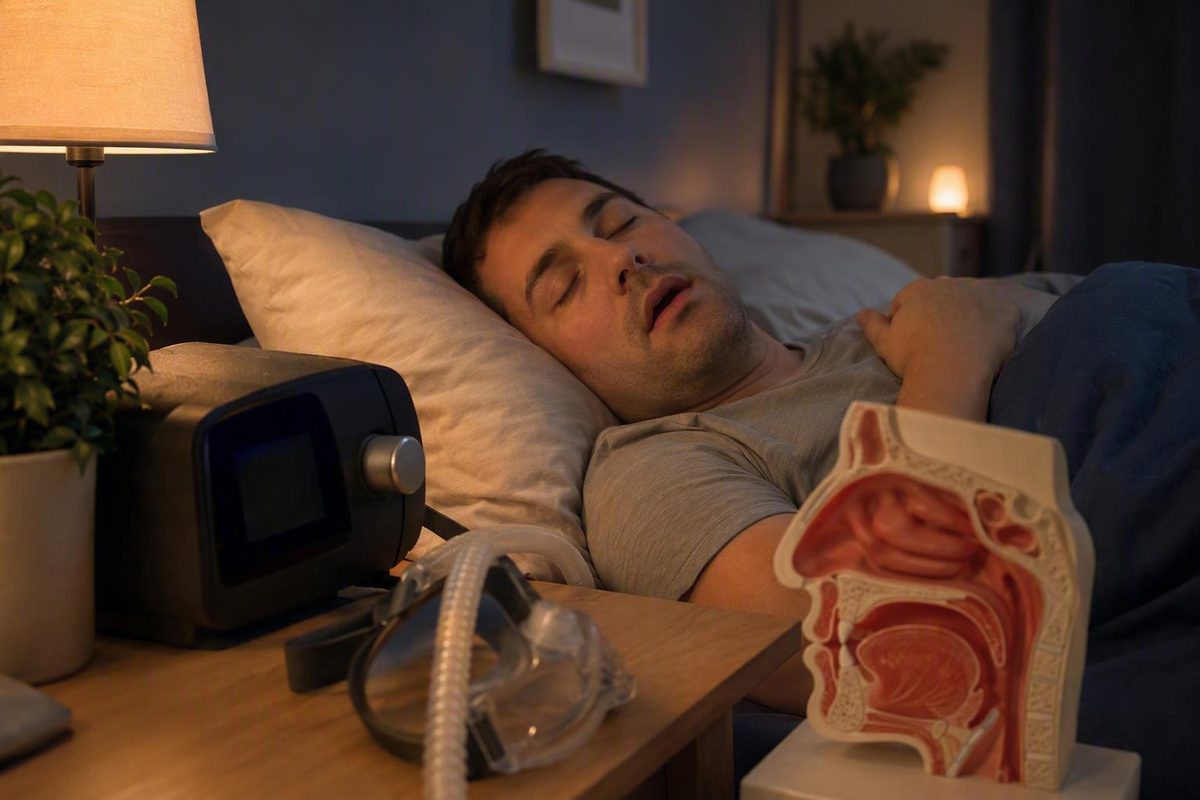
A deviated septum is usually not the sole cause of obstructive sleep apnea (OSA), but a severe deviation can narrow the nasal airway and contribute to difficult nighttime breathing. It may worsen snoring or existing OSA, and it can make treatments such as CPAP less comfortable. Correcting the septum can improve nasal breathing, but it does not reliably cure OSA by itself.
That distinction matters because a blocked nose and sleep apnea can feel similar while requiring different tests and treatments. A clinician can examine the nose, but a sleep study is generally needed to diagnose OSA.
How a deviated septum and OSA are connected
The septum is the wall of bone and cartilage between the two sides of the nose. When it is far enough off-center, one nasal passage may be much narrower than the other. Swelling from allergies, a cold, or chronic nasal inflammation can make that narrowing more noticeable.
OSA is different. It occurs when the upper airway becomes repeatedly blocked during sleep. The National Heart, Lung, and Blood Institute (NHLBI) explains that this blockage can reduce or stop airflow. In many adults, the important collapse is farther back in the upper airway, around structures such as the soft palate, tongue, and throat—not just at the nasal septum. Central sleep apnea has another mechanism entirely: the brain does not send the signals needed to breathe.
A narrowed nasal passage can still matter. It increases resistance to airflow and may encourage mouth breathing. That can add to an already vulnerable airway, disturb sleep, aggravate snoring, or make positive-airway-pressure treatment harder to tolerate. It is best understood as one possible contributor within a multi-factor problem, not a universal explanation for OSA.
Research supports a connection but does not prove that the septum alone causes apnea. A nine-year Korean insurance-database study found substantially more OSA diagnoses among people coded as having septal deviation than among matched controls. Because this was an observational study based on diagnoses and claims—not a trial that randomly assigned anatomy—it shows association, not individual cause and effect. Other influences, including weight, age, throat and jaw anatomy, tonsil size, alcohol or sedative exposure, and medical conditions, may also affect risk.
Which symptoms point to the nose, and which point to sleep apnea?
Some symptoms overlap, especially snoring and poor sleep. The pattern provides clues, but symptoms alone cannot confirm either condition.
Signs that can fit a symptomatic deviated septum include:
- persistent difficulty breathing through one or both nostrils, often worse on one side;
- chronic nasal congestion, noisy nasal breathing, or recurrent nosebleeds;
- reduced sense of smell or facial pressure; and
- mouth breathing or snoring that becomes worse when the nose is congested.
Signs that should raise concern for OSA include:
- repeated pauses in breathing witnessed by another person;
- gasping, choking, or loud habitual snoring during sleep;
- excessive daytime sleepiness despite enough time in bed;
- morning headaches, dry mouth, or unrefreshing sleep; and
- trouble concentrating, remembering, or staying alert.
Snoring by itself does not prove OSA, and quiet sleep does not rule it out. A blocked nostril also cannot show how often breathing stops, whether oxygen falls, or where the airway collapses.
How clinicians tell the conditions apart
An ear, nose, and throat (ENT) clinician can assess nasal obstruction and look for a displaced septum, enlarged turbinates, nasal valve narrowing, polyps, or inflammation. According to the Cleveland Clinic’s medically reviewed overview, the examination may use a nasal speculum, and some people need nasal endoscopy or imaging to see deeper structures. A visible deviation does not automatically mean it is severe enough to explain symptoms.
OSA requires a sleep-focused evaluation. The American Academy of Sleep Medicine diagnostic guideline recommends that testing be paired with a comprehensive sleep assessment and follow-up. Polysomnography in a sleep laboratory is the standard diagnostic test. A technically adequate home sleep apnea test may be appropriate for certain uncomplicated adults with symptoms suggesting moderate-to-severe OSA. If a single home test is negative, inconclusive, or technically inadequate while concern remains, the guideline recommends polysomnography rather than assuming there is no apnea.
Online questionnaires, phone recordings, and wearable data can help start a conversation, but they should not be treated as a diagnosis. An ENT evaluates the nose; a sleep clinician evaluates the repeated breathing disorder. Some people need both assessments.
Will septoplasty cure sleep apnea?
Usually, no. Septoplasty straightens the septum and can be an appropriate treatment for bothersome structural nasal obstruction. Its most predictable goal is easier nasal breathing—not eliminating every site of airway collapse during sleep.
An updated systematic review of isolated nasal surgery in adults with OSA found that most included studies did not show a significant improvement in the apnea-hypopnea index (AHI), the measure of breathing events per hour. The pooled AHI reduction was small and the studies varied greatly. Subjective sleepiness often improved, creating an important but limited conclusion: people may breathe or feel better even when objective OSA is not resolved.
Nasal surgery may still be useful as one part of care when a person has clinically important nasal obstruction. It may:
- improve airflow through the nose;
- reduce nasal discomfort with a CPAP mask;
- make CPAP easier to use consistently or allow retitration to a different pressure; and
- improve congestion-related sleep complaints or snoring in some people.
Those potential benefits do not justify stopping CPAP, an oral appliance, or another prescribed OSA treatment after septoplasty. A person with diagnosed OSA should keep using prescribed therapy unless the treating clinician changes the plan. If surgery may have altered OSA severity, the clinician can decide whether repeat sleep testing is appropriate.
The reverse is also true: treating OSA does not straighten a deviated septum. The two problems may need coordinated but separate management.
What to do if you have nasal blockage and possible apnea
Use the symptom pattern to choose a next step without trying to diagnose yourself:
- If someone notices breathing pauses, gasping, or choking, or you have persistent daytime sleepiness, arrange a sleep evaluation. Do not wait for septum surgery to determine whether OSA is present.
- If one-sided nasal blockage, nosebleeds, or impaired nasal breathing is persistent, ask for a nasal examination. An ENT can determine whether the septum, inflammation, or another nasal problem is responsible.
- If you already use CPAP and nasal blockage makes it difficult, contact the prescribing sleep team. Mask style, humidification, treatment of nasal inflammation, pressure settings, or an ENT evaluation may help. Do not change pressure or abandon treatment on your own.
- Discuss the goal of any proposed septoplasty. Ask whether the goal is better nasal breathing, easier CPAP use, less snoring, or a measurable change in OSA. The expected result is not the same for each goal.
The NHLBI treatment guide describes positive-airway-pressure devices, oral devices, individualized lifestyle changes, and selected procedures among the options used to keep the airway open. The right combination depends on sleep-test findings, symptoms, anatomy, other health conditions, and patient preferences.
Avoid driving or operating machinery when you are dangerously sleepy. Seek prompt medical care for new severe breathing difficulty or a significant nasal injury, and tell a clinician if nighttime breathing symptoms are getting worse.
Bottom line
A deviated septum can restrict nasal airflow and may contribute to snoring, poor sleep, CPAP difficulty, or worse obstructive sleep apnea. It is rarely a complete explanation for OSA, because apnea usually involves repeated collapse elsewhere in the upper airway and often has several contributing factors.
Septoplasty can be valuable for the right nasal problem, but improved nasal breathing is not the same as a proven OSA cure. The safest sequence is to evaluate suspected apnea with appropriate sleep testing, evaluate persistent nasal obstruction directly, and build a treatment plan that addresses both when both are present.