
6 min read ·
Sleep Apnea Improves With Treatment, Not Without It
Some people reach remission after weight loss or treatment of a specific airway problem. Symptoms alone cannot confirm it, but follow-up testing can.
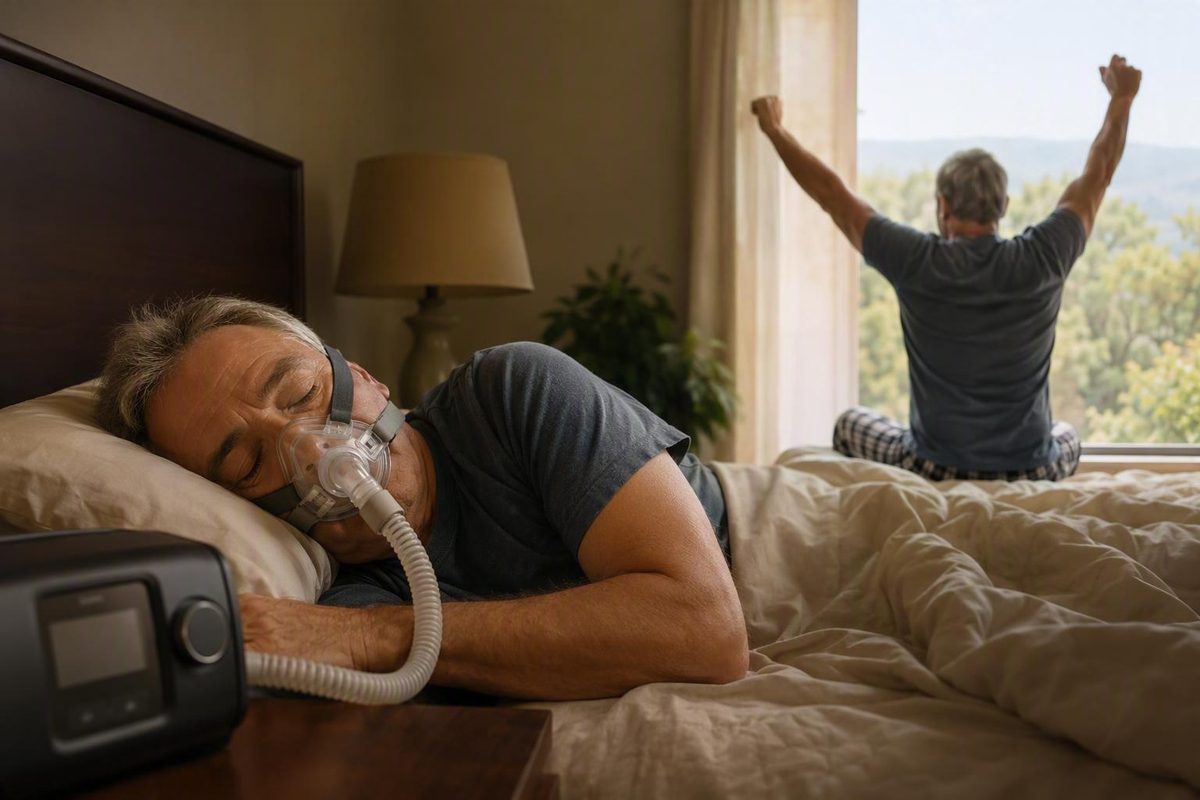
Sleep apnea usually does not simply go away on its own. It can improve, and some people reach remission after a meaningful change such as weight loss or treatment of a specific airway problem. But improvement is not the same as a confirmed cure. The only safe way to know whether sleep apnea is still present—and whether treatment should change—is to review the change with a sleep clinician and, when appropriate, repeat an overnight sleep study or home sleep apnea test.
If you use CPAP, bilevel PAP, oxygen, an oral appliance, or another prescribed treatment, keep using it as directed unless your clinician tells you otherwise. Feeling better or snoring less does not prove that breathing pauses have stopped.
The answer depends on the type of sleep apnea
“Sleep apnea” describes more than one breathing disorder. The underlying mechanism matters when asking whether it can resolve.
Obstructive sleep apnea
Obstructive sleep apnea (OSA) happens when the upper airway repeatedly narrows or closes during sleep. The National Heart, Lung, and Blood Institute (NHLBI) lists risk factors that may change, such as excess weight, alcohol use, and smoking, as well as factors that may not, including age, family history, and features of the neck, tongue, face, or airway.
OSA may become milder if a major contributor changes. Examples include weight loss in a person whose OSA is strongly weight-related, treatment of enlarged tonsils, or a procedure that corrects a carefully identified anatomic obstruction. Even then, residual OSA is possible because several factors often contribute at once. OSA can also recur after weight regain, aging, or another change in health or anatomy.
Central sleep apnea
Central sleep apnea (CSA) is different: breathing pauses occur because the brain does not consistently send the right signals to the breathing muscles. NHLBI notes that heart failure, stroke, certain neuromuscular conditions, and long-term opioid use can be associated with CSA.
CSA may improve when its underlying cause can be effectively treated or a contributing medicine can be safely changed. Its course is therefore highly individual. Do not reduce or stop an opioid or any other prescribed medicine on your own; the clinician who manages it needs to weigh withdrawal, pain control, and breathing risks. CSA also requires a different evaluation and may require different treatment from OSA.
Remission, control, and cure are not the same
These terms are easy to blur:
- Controlled: Treatment prevents or greatly reduces breathing events while you use it. CPAP is the clearest example: it provides air pressure that keeps the airway open, but it usually does not permanently change the airway.
- Improved: Symptoms or the number of breathing events have decreased, but sleep apnea may still be present.
- Remission: Follow-up testing no longer meets the diagnostic threshold at that time. Remission can last, but it does not guarantee the condition can never return.
- Cured: This implies a durable elimination of the disorder and its cause. Clinicians tend to use this word carefully because sleep apnea can have several causes and can recur.
Snoring is not a reliable at-home test. Some people with OSA do not snore loudly, and a quiet night does not show what happened to airflow, breathing effort, or blood oxygen. Daytime energy can also improve before OSA fully resolves—or stay poor for reasons unrelated to sleep apnea.
When can obstructive sleep apnea improve or enter remission?
Weight loss
For people with overweight or obesity, weight loss often reduces OSA severity, but it does not guarantee remission. An official American Thoracic Society clinical practice guideline found that comprehensive lifestyle interventions are associated with lower OSA severity and better daytime sleepiness, and may lead to resolution in some people. Outcomes vary with baseline severity, anatomy, the amount and durability of weight change, sleep position, and other health factors.
Weight management is best viewed as part of treatment rather than permission to stop treatment. It may also change the PAP pressure needed for effective therapy.
Surgery or treatment of a specific obstruction
Removing enlarged tonsils, advancing the jaw, or performing another airway procedure can substantially improve OSA in a carefully selected patient. Results vary by procedure and by the obstruction being treated. A procedure that reduces nasal blockage, for example, may make PAP easier to use without eliminating collapse elsewhere in the throat.
The NHLBI treatment overview describes PAP, oral devices, orofacial therapy, nerve stimulation, tonsillectomy, jaw advancement, and other operations as different options—not interchangeable cures. Selection should follow an evaluation by a sleep clinician and, depending on the option, an experienced dentist or surgeon.
Position and lifestyle changes
Side sleeping, limiting alcohol, quitting smoking, and maintaining a healthy weight may reduce OSA in some people. Positional therapy can be particularly useful when events occur mainly while sleeping on the back. These measures may be enough for a subset of mild cases, but symptoms alone cannot confirm that they are enough for you.
Changes during childhood and aging
Children may have OSA related to enlarged tonsils or adenoids, obesity, craniofacial anatomy, or other conditions. Treatment can resolve OSA for some children, but it is unsafe to assume a child will simply “grow out of it.” Persistent snoring, labored breathing during sleep, attention or behavior concerns, bed-wetting, or daytime sleepiness deserve pediatric evaluation.
In adults, getting older can increase OSA risk because airway tissues, muscle tone, weight, medications, and health conditions may change. Someone who once had mild or resolved OSA can therefore need reassessment later.
Why you should not stop CPAP based on symptoms alone
CPAP works by holding the upper airway open while you sleep. If the underlying tendency to collapse remains, apnea can return as soon as CPAP is not used—even if treatment has made you feel dramatically better.
The Mayo Clinic’s sleep apnea treatment guidance specifically advises people not to stop CPAP when they have problems with it, but to ask their healthcare professional about adjustments. Mask fit, dryness, pressure comfort, congestion, and leaks often have workable solutions. A clinician can also discuss another PAP mode, an oral appliance, or a different treatment when appropriate.
Stopping treatment without confirmation can allow breathing pauses, oxygen drops, fragmented sleep, and daytime sleepiness to return unnoticed. If you are sleepy enough that driving feels unsafe, do not drive; arrange another way to travel and contact a healthcare professional promptly.
When repeat testing makes sense
A sleep clinician may consider follow-up polysomnography or a home sleep apnea test when:
- symptoms return or continue despite good treatment use;
- there has been clinically significant weight loss or gain;
- you have completed surgery, an oral-appliance adjustment, or another non-PAP treatment;
- PAP device data are unexplained or the treatment no longer seems effective;
- cardiovascular or other health circumstances have changed in a way that may affect sleep-related breathing.
AASM guidance on longitudinal OSA management says routine repeat testing is not generally needed for an asymptomatic person doing well on PAP, but follow-up testing may be used after clinically significant weight change or in other situations where the result could change management.
Ask the clinician what type of test fits your situation. A home test is not appropriate for every person or every suspected type of apnea, and a negative home result may not settle the question when symptoms or medical risk remain concerning.
A practical next-step checklist
- Keep using prescribed treatment. Do not run a personal “trial” without CPAP or another therapy to see how you feel.
- Record what changed. Note weight change, surgery, new medicines, alcohol use, sleep position, recurrent snoring, witnessed pauses, morning headaches, and daytime sleepiness.
- Check treatment problems early. Contact your sleep clinic or equipment provider about mask leaks, pressure discomfort, dryness, or persistent symptoms instead of abandoning PAP.
- Ask whether reassessment could change care. Your clinician can decide whether device-data review, a home test, or laboratory polysomnography is appropriate.
- Change treatment only from the results and clinical plan. If testing shows remission, ask what follow-up is needed and what changes should trigger another evaluation.
The useful answer is therefore not simply “yes” or “no.” Sleep apnea can sometimes improve enough to enter remission, especially when a major reversible contributor is addressed. For many people, however, it remains a long-term condition that is controlled rather than erased. Confirmation—not the absence of snoring or a few good nights—is what makes a treatment change safe.