
Feature
Unpacking Energy Triangles in Meditation – From Esoteric Visualizations to Proven Rest Strategies
Petra Halloran · · 20 min
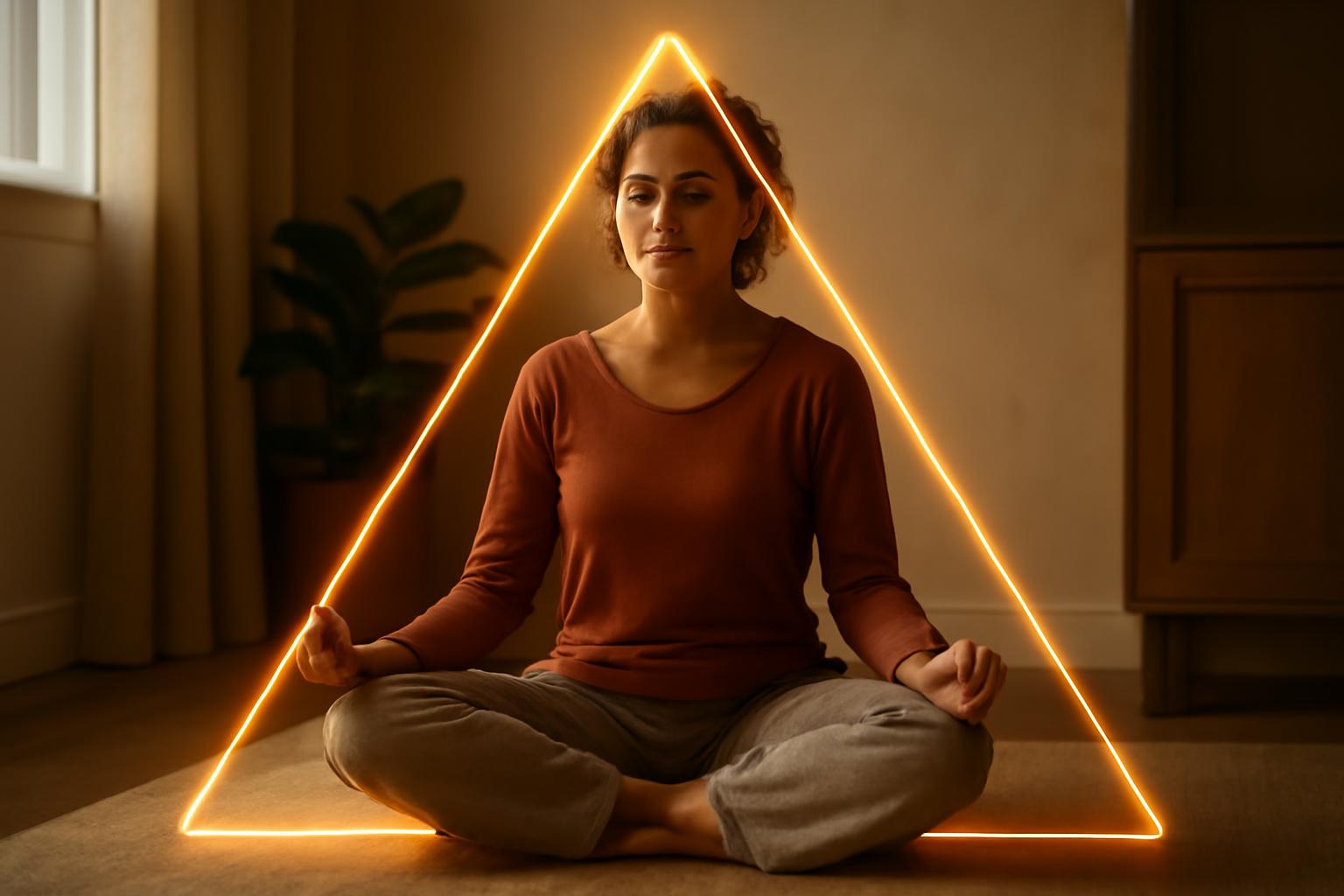
If you searched for meditation energy trangles, you likely mean meditation energy triangles. The phrase sounds specific, but in practice it is not one standardized method. In the material reviewed here, “energy triangles” can refer to:
- a triangle of light mentally linking three people
- intersecting upward and downward triangles in chakra teachings
- a three-stage breathing rhythm
- pyramid or tetrahedron-inspired meditation gestures and postures
That variety matters. Most of the available material comes from spiritual teachings, guided meditations, yoga blogs, and promotional wellness pages, not from peer-reviewed research on measurable “energy” effects. So the most accurate way to approach the topic is descriptive rather than credulous: these practices are part of esoteric, symbolic, or contemplative traditions, and the stronger claims attached to them are not scientifically verified in the sources reviewed here.
Still, the topic is worth unpacking on its own terms. Many readers are not asking for a medical answer; they want to know what triangle meditations are, how different traditions use them, and where symbolism ends and evidence begins. This article stays centered on that question first. Then, because “energy” is also commonly used to mean alertness or reduced tiredness, it briefly covers the sleep science that speaks to that separate issue.
What Are Meditation Energy Triangles?
“Energy triangles” in meditation usually means one of a few different things, depending on the teacher or lineage.
One version is a three-person visualization practice. In that model, three people are linked mentally through a triangle of light, purpose, or goodwill. The triangle is treated as a subtle spiritual structure through which intention circulates. This appears in global meditation materials that frame the practice as service, healing, or contribution to a wider field of consciousness.
Another version comes from subtle-body and chakra teachings. In a 2016 Isha Foundation article presenting Sadhguru’s teaching, the human energy system is described as involving two equilateral triangles: one upward-pointing and one downward-pointing, normally meeting above the anahata, or heart chakra. In ideal alignment, those triangles are said to form a six-pointed star. That is a specific spiritual teaching, not a cross-tradition scientific finding.
A third version uses the triangle more simply as a meditation structure. Instead of claiming hidden geometry in the body, a teacher may use three points to organize attention: three breaths, three qualities, three people, or three directions of contemplation. In that sense, the triangle functions less like anatomy and more like a mnemonic or ritual form.
For beginners, it helps to separate three layers that often get blurred together:
- Symbol: a triangle stands for balance, union, ascent and descent, or three related qualities.
- Practice: you visualize, breathe through, or contemplate the triangle.
- Claim: the triangle is said to direct subtle forces, heal imbalances, or alter reality.
The first two layers are easy to document in the source material. The third is where support weakens sharply.
A fair summary of the reviewed material is this: meditation energy triangles are best understood as spiritual symbols and practice frameworks. They may be meaningful within a given tradition. But the sources do not establish that triangles channel a measurable healing force or regulate human biology in a scientifically confirmed way.
That distinction does not make the practices meaningless. A symbolic form can still give a person a pattern for attention, reflection, or ritual. It just should not be mistaken for verified physiology.
Triangle Visualizations and Global Networks
One of the clearest triangle-based practices is the global triangles model. In descriptions of this practice, you mentally form a triangle with two other people. The three points are visualized as connected by light, and that triangle is then imagined as part of a larger worldwide network surrounding the Earth.
The practice instructions in the material reviewed here are fairly concrete. Participants are typically told to:
- sit quietly for a few minutes, often daily
- align in thought with two other people
- visualize the three points connected as a triangle of light
- imagine that triangle linking into a planetary web or grid
- recite the Great Invocation or another set spiritual text
The same materials say the practice can be done daily, often in the morning, and asynchronously rather than in real-time synchrony. They also mention networks associated with Lucis Trust for people who want to join or register a triangle.
Taken descriptively, this is a well-defined spiritual ritual. It has a social element, a repeated visualization, and a clear symbolic logic: three people become a triangle; many triangles become a grid; the grid becomes a vehicle for goodwill or service.
But the stronger claims made around the practice deserve careful handling. Materials describing global triangles speak of earth healing, helping humanity, or benefiting plant and animal kingdoms. The existence of an organized practice community does not verify those outcomes. It shows that the practice is real as a tradition, not that its metaphysical effects have been scientifically demonstrated.
A related but more inward version appears in a short guided meditation on Insight Timer built around a sacred triangle of Light, Love, and Wisdom. Here the triangle is not a global network but an internal contemplative map. Each point represents one inner quality, and the practitioner reflects on how those qualities relate.
This second approach is easier to translate into a beginner exercise because it requires less metaphysical commitment. You can use the triangle simply as a three-part reflection tool:
- name three qualities
- imagine each one at a point of a triangle
- notice which quality feels strong, weak, or neglected
Used that way, the triangle is functioning as a symbolic organizer of attention, not as a claim about invisible mechanics.
So although global triangle meditation and inner sacred-triangle meditation look similar on the surface, they operate differently:
- Global triangle practice emphasizes shared purpose and a planetary spiritual network.
- Inner triangle practice emphasizes contemplation of three values or qualities.
For a beginner, the most grounded reading is to treat both as ritualized visualization practices. They may offer meaning, structure, and a sense of connection. The sources reviewed here do not, however, provide scientific verification for the claims of energy transmission or planetary healing that sometimes accompany them.
Triangles in Chakra Systems and Symbols
Triangles are common in chakra imagery, but they are not used in one uniform way across all systems.
In the Sadhguru/Isha presentation already mentioned, the human energy system is described as containing two equilateral triangles, upward and downward, meeting above the heart center. That same source also says the body contains 114 chakras, with 112 within the physical realm, and describes chakras as triangular structures rather than wheels. This is a striking example of how much chakra teachings can vary by school, because the word chakra is commonly translated as wheel or circle.
More familiar seven-chakra systems also use triangles in their iconography. In the yoga guides reviewed here, examples include the following:
- Root chakra: often shown with a square and a downward or inverted triangle
- Solar plexus chakra: shown in one guide with a downward triangle
- Heart chakra: shown in one guide with intersecting triangles
- Throat chakra: shown in one guide as an inverted triangle within a circle
- Third eye chakra: shown in multiple guides with an inverted triangle
Those details need qualification. They are not universal scientific diagrams; they are tradition-specific symbolic designs found in chakra literature. Even among popular wellness explanations, the iconography and counts vary. One source speaks of 109 chakras, another of 114, while more introductory systems focus on seven main chakras for practical meditation.
The symbolism itself is interpreted in several ways, depending on the source:
- upward and downward motion
- elemental association
- balance of complementary principles
- artistic convention within chakra iconography
- subtle-body metaphysics
The heart chakra is a useful example. In one seven-chakra guide, it is depicted with intersecting upward and downward triangles, often read as a union of opposite but complementary forces. In another teaching, the emphasis falls less on triangles and more on color, petals, or emotional association. That inconsistency is exactly why broad statements about “what triangles mean in the chakras” need caution.
The same caution applies to claims about prana, or life-force. The yoga sources reviewed here describe chakras as energy centers connected by subtle channels through which life-force flows. One source explicitly states that chakras are located in the astral body and cannot be measured by instruments or confirmed visually. That is important context. These are spiritual models of human experience, not established anatomical findings.
For a reader trying to make sense of triangle symbols in chakra meditation, the safest conclusion is:
- triangles are genuinely present in many chakra diagrams
- their meaning varies by lineage
- they belong to a subtle-body belief framework
- the sources reviewed here do not show that these symbols map onto measurable bodily structures
That does not strip the symbols of value. Within meditation, symbolic images often act as memory aids, contemplative anchors, or ritual language. A downward triangle in a chakra symbol can help a practitioner remember a traditional association. But moving from “this is a traditional image” to “this image objectively regulates invisible energy” goes beyond what the material supports.
Breathing Patterns and Pyramid Techniques
Not every triangle practice is about chakras. Some are simply about shape as a way of organizing breath or posture.
A clear example is triangular breathing. In a 2025 article by meditation teacher Toby Ouvry, triangular breathing is defined as a three-stage rhythm:
- inhale
- exhale
- pause at the bottom of the breath
It is called “triangular” because it has three stages, unlike square breathing, which has four. That makes the triangle a practice mnemonic. You are not required to believe in chakras or sacred geometry to understand the exercise. It is simply a structured breathing pattern.
That makes triangular breathing one of the more accessible triangle-related practices for beginners. A stripped-down version might look like this:
- inhale gently for a comfortable count
- exhale gently for a comfortable count
- rest briefly at the bottom of the breath
- repeat for a few rounds without strain
In the source, the teacher pairs this kind of breathing with different mental qualities or states. But those added outcomes are part of the teacher’s own method. The materials reviewed here do not establish that triangular breathing produces unique “energy” effects beyond being a particular way to pace attention and breath.
A more speculative branch of the triangle theme appears in pyramid and tetrahedron practices. In one yoga-oriented blog post, triangles and pyramids are presented as fundamental forms that supposedly transform or direct energy upward. Suggested methods include:
- touching fingers and thumbs together to form a triangle
- bringing that hand triangle toward the forehead or “third eye”
- viewing the seated cross-legged body as a tetrahedral shape
- using pyramid objects, crystal pyramids, or pyramid-like structures nearby
The same post includes anecdotal stories about a pyramid hat and a bamboo pyramid bed for better sleep or clarity. Those stories are personal reports, not research findings. The page does not provide controlled studies showing that pyramids change sleep, focus, or any measurable energy variable.
So within this section, the evidence-aware distinction is straightforward:
- Triangular breathing is a recognizable breath-structure exercise.
- Pyramid energy techniques are much more belief-dependent and anecdotal.
If you are curious and want the lowest-risk interpretation, treat the triangle here as a form cue. It can help remember a breathing sequence or create a deliberate ritual posture. The reviewed sources do not support claims that triangle or pyramid shapes have demonstrated special powers.
Caveats and Lack of Scientific Support
This is the part that keeps the rest of the article honest.
Across the material reviewed here, triangle practices are described in ways that are spiritually vivid but evidentially thin. The sources show that these beliefs and rituals exist, sometimes in quite detailed form. They do not provide strong empirical support for the more ambitious claims attached to them.
A few examples illustrate the pattern:
- global triangle materials describe a planetary light network and earth-healing intent, but do not provide scientific verification for those effects
- pyramid and tetrahedron practices rely mainly on anecdote, personal belief, and sacred-geometry interpretation
- chakra geometry teachings present specific metaphysical claims about triangles in the energy body without showing that those structures can be independently measured
- guided meditations describing sacred triangles of inner qualities present likely benefits such as clarity or harmony as part of the meditation’s framing, not as tested findings
The clearest mainstream caveat in the evidence pack comes from a Verywell Mind explainer on chakra meditation, which states plainly that chakras are not scientifically recognized and are part of a belief system. That sentence gives the cleanest overall framing for triangle-based chakra claims as well. They may be meaningful inside a spiritual tradition, but they are not validated scientific entities.
That does not require a hostile reading. A practice can be personally meaningful without being scientifically established. Many people use symbolic meditation forms because they support reflection, ritual, or focus. The problem begins when symbolic or devotional language is presented as if it were equivalent to verified physiology.
The sleep-focused material reviewed alongside these sources uses a much stricter standard: it is framed around peer-reviewed short-sleep research, and the site terms explicitly state that its articles are informational only and not medical advice. That contrast matters because the word energy gets used in two very different ways online:
- esoteric energy: prana, subtle force, planetary light, chakra flow
- physiological energy: alertness, wakefulness, reduced sleepiness
Meditation energy triangles belong to the first category. Sleep science belongs to the second.
So if the question is, “Are energy triangles scientifically proven?” the answer supported by the reviewed material is no. If the question is, “Can triangle imagery still function as a meaningful spiritual practice?” the answer is possibly yes, but that does not validate the stronger metaphysical explanations offered around it.
Science of Energy: Sleep Pressure and Adenosine
This section addresses a narrower question: if by “energy” you mean feeling less tired and more alert, what does the evidence reviewed here point to?
In that everyday sense, the key concept is sleep pressure. The sleep material in the evidence pack explains that adenosine builds during waking hours and drives the need for sleep. A nap partially clears that buildup, which is one reason napping can temporarily reduce sleepiness.
That model gives a very different explanation for low energy than spiritual triangle language does. If you feel heavy, sleepy, or foggy in the afternoon, the reviewed sleep material points first to factors such as:
- accumulated sleep debt
- circadian timing
- insufficient or poor-quality night sleep
- sleep disruption
- possible sleep disorders
The same material notes that daytime sleepiness can be a sign of conditions such as insomnia or obstructive sleep apnea, not just a cue to optimize naps or layer on more wellness techniques.
There is also important variation from person to person. The reviewed guidance emphasizes that nap response and sleep architecture differ between individuals. Some people become groggy quickly after even a short nap; others tolerate longer naps better. That is why population-level advice is useful as a starting point, not as a guarantee.
So when the topic shifts from spiritual symbolism to ordinary alertness, the hierarchy changes. The evidence reviewed here supports looking first at:
- nighttime sleep sufficiency and quality
- whether sleepiness may reflect a sleep problem
- nap timing and duration, when naps are appropriate
- individual response
- medical evaluation for persistent or disproportionate tiredness
That does not mean meditation has no place in someone’s life. It means that if the problem is specifically sleepiness, the relevant evidence in this source set concerns sleep regulation, not triangle geometry.
Proven Nap Durations for Alertness
If your real goal is not spiritual exploration but a practical alertness boost, the reviewed sleep material gives fairly clear population-level guidance on nap length.
The most useful starting point is 10 to 20 minutes. According to the nap-length summary in the evidence pack, this is the classic power nap window because it usually avoids slow-wave sleep. Recovery to full alertness is often fast, and the benefit can last 1 to 3 hours after waking.
That same source cites a 2006 NASA study in sleepy military pilots in which a 26-minute nap improved alertness by 34% and performance by 16%. The exact study used 26 minutes, so it should be read as support for the short-nap approach, not as proof that 26 is a universal magic number.
The reviewed material is much more cautious about 30 to 60 minutes. That range often reaches slow-wave sleep, which increases the chance of sleep inertia after waking. In practical terms, that means a nap that leaves you feeling more disoriented, heavy, or mentally slow for a while.
A 90-minute nap is the other duration the evidence pack treats as potentially useful. The idea is to complete a full sleep cycle, including REM, and wake at a point where inertia is lower than it often is from a mid-length nap. The tradeoff is time. This is generally less practical as an everyday afternoon tool.
The source also describes a caffeine nap: consume about 100 to 200 mg of caffeine immediately before a 20-minute nap. Because caffeine takes roughly 20 to 30 minutes to begin blocking adenosine receptors, the nap and stimulant effect can line up. The reviewed summary says multiple studies find better alertness from this combination than from caffeine or a nap alone.
Timing matters too. The same material advises keeping naps before 3 p.m. if your usual bedtime is around 10 to 11 p.m., since late naps can delay sleep onset.
Two cautions are worth keeping attached to all of this:
- the nap advice is population-level, not individualized treatment
- the source itself notes that some people reach deeper sleep faster than others
So the practical takeaway is narrow: if you mean alertness, the best-supported starting points in this evidence pack are short naps, careful timing, and personal testing of response.
When to Avoid Naps for Better Energy
Even if naps can help in the right circumstances, the reviewed sleep material also makes clear that they are not always a good idea.
One major exception is chronic insomnia. The source explains that insomnia is often maintained by low sleep pressure at bedtime. Because adenosine is partially cleared by a nap, daytime sleep can reduce the pressure that would otherwise help you fall asleep that night. For that reason, CBT-I, the first-line treatment for insomnia, restricts daytime napping.
Another problem is using naps to compensate for chronically poor night sleep. If you are sleeping only 5 to 6 hours per night and relying on a long daily nap, the nap may make that pattern easier to maintain rather than helping fix it. The sleep material describes this as delaying the real solution, which is night sleep.
The same source flags long naps over 30 minutes as a caution in the context of depression. It says multiple studies show a correlation between longer daytime sleep and worse depressive symptoms, while also noting that the direction of cause and effect is still debated. Short naps under 20 minutes appear more neutral in that summary.
With obstructive sleep apnea, frequent naps can also be misleading. Excessive daytime sleepiness is a primary symptom of sleep apnea. In that situation, the nap does not address the underlying problem of fragmented sleep; it only compensates for it.
The reviewed material also warns against poorly timed long naps before a high-stakes evening event, because sleep inertia can be especially disruptive when you need to be sharp.
Finally, it lists signs that the nap need may be more symptom than strategy:
- you need more than 30 minutes and still do not feel restored
- you fall asleep in under 5 minutes consistently
- you wake from naps confused or disoriented
- daily napping becomes a new persistent need
Those signs point less toward “better nap optimization” and more toward reviewing your sleep habits carefully and considering professional evaluation.
Practical Steps: From Triangles to Targeted Rest
If you came here mainly wanting to understand meditation energy triangles, the most balanced approach is not to mock the practice or overstate it. It is to use it within the limits of what the evidence supports.
Here is a practical way to do that.
1. Decide what you mean by “energy.” If you mean spiritual reflection, ritual, or symbolic meditation, triangle practices belong in that conversation. If you mean alertness, wakefulness, or less daytime sleepiness, the relevant material in this evidence set is about sleep pressure and nap timing.
2. Treat triangle practices as symbolic unless a tradition-specific meaning matters deeply to you. The reviewed sources support saying that triangles are used in meditation as symbols of balance, connection, polarity, or threefold qualities. They do not support treating triangles as scientifically demonstrated energy devices.
3. Start with the least loaded triangle practice. For beginners, the most bounded options from the source material are: - a three-person goodwill visualization - an inner triangle of values such as Light, Love, and Wisdom - triangular breathing with inhale, exhale, and a bottom pause
These can be explored without assuming planetary grids, hidden anatomy, or special geometric powers.
4. Keep chakra symbolism in its proper category. If you use chakra images, treat them as traditional iconography within a subtle-body worldview. Different lineages disagree about counts, symbols, and meanings. That variation is a reason for humility, not for certainty.
5. If your actual problem is tiredness, look at sleep first. The reviewed sleep material is clearest on this point: naps are most straightforwardly useful for healthy adults with adequate night sleep who want help with a predictable afternoon dip or a specific alertness task.
6. Use population-level nap rules conservatively. A reasonable starting framework from the evidence pack is: - 10–20 minutes for a power nap - avoid 30–60 minutes when possible - 90 minutes only when you truly want a full cycle - keep naps before 3 p.m. - consider a caffeine nap only if caffeine suits you
Then test your own response rather than forcing the numbers.
7. Watch for red flags instead of spiritualizing persistent sleepiness. Consistent under-5-minute sleep onset, new daily nap dependence, waking confused, suspected insomnia, or possible sleep apnea are health issues, not signs that you need more elaborate geometry.
8. Keep all of this in perspective. Triangle meditation may be spiritually rich for some people. The stronger metaphysical claims around it remain unsupported in the reviewed material. By contrast, short naps have a clearer evidence base for improving alertness in appropriate situations. And if tiredness is persistent, an article cannot replace an evaluation by a qualified healthcare professional.
Are meditation energy triangles scientifically proven?
No. In the reviewed material, triangle practices are presented as spiritual teachings, symbolic meditation forms, or personal methods. The sources do not provide scientific proof that triangles transmit healing energy, balance chakras in a measurable way, or create verified planetary effects.
The most defensible framing is that these practices are part of belief-based contemplative systems. That does not prevent them from feeling meaningful to practitioners, but it does mean the strongest claims remain unverified.
Which chakras feature triangle symbols?
Triangle symbols appear in several chakra guides, but not every lineage uses the same iconography.
In the reviewed material, examples include:
- Root chakra: often shown with a downward or inverted triangle
- Solar plexus chakra: shown in one guide with a downward triangle
- Heart chakra: shown in one guide with intersecting triangles
- Throat chakra: shown in one guide with an inverted triangle inside a circle
- Third eye chakra: shown in multiple guides with an inverted triangle
These should be read as traditional symbolic designs, not as scientifically validated anatomical maps.
What’s the best nap for an energy boost?
For most healthy adults, the best first option in the reviewed sleep material is a 10 to 20 minute nap. That range is short enough to reduce the chance of waking from deep sleep, so it tends to produce less grogginess.
The same source cites a 2006 NASA study in which a 26-minute nap improved sleepy pilots’ alertness by 34% and performance by 16%. That supports the general short-nap approach. If you need more recovery and have the time, a 90-minute nap can also work because it aims to complete a full sleep cycle. The reviewed guidance advises avoiding 30 to 60 minutes when possible and keeping naps before 3 p.m.
When does napping reduce energy instead of helping?
Napping can backfire when it reduces the sleep pressure you need later or leaves you in sleep inertia.
The reviewed sleep material highlights several common cases:
- chronic insomnia, where naps make it harder to fall asleep at night
- long naps over 30 minutes, which are more likely to cause grogginess and are linked with worse depressive symptoms
- sleep apnea, where frequent naps may mask a sleep-quality problem rather than solve it
- late-day naps, which can delay bedtime sleep
- waking confused or disoriented after naps
If you regularly fall asleep in under 5 minutes, need long naps daily, or still feel unrefreshed after napping, the issue may need clinical evaluation.
Is this site giving medical advice on energy or sleep?
No. The site terms state that its content is for general information only and is not medical advice. They also advise readers with sleep disorders, excessive daytime sleepiness, or other health concerns to consult a qualified healthcare provider.
That matters here because the article covers two different domains: spiritual meditation beliefs and sleep-related alertness guidance. Neither should be used as a substitute for individualized medical care.