
5 min read ·
Pilots Can Nap During Some Flights—But Only Under a Defined Procedure
Pilots may sleep during approved crew rest or controlled cockpit rest. Here is how EASA and U.S. airline procedures differ.
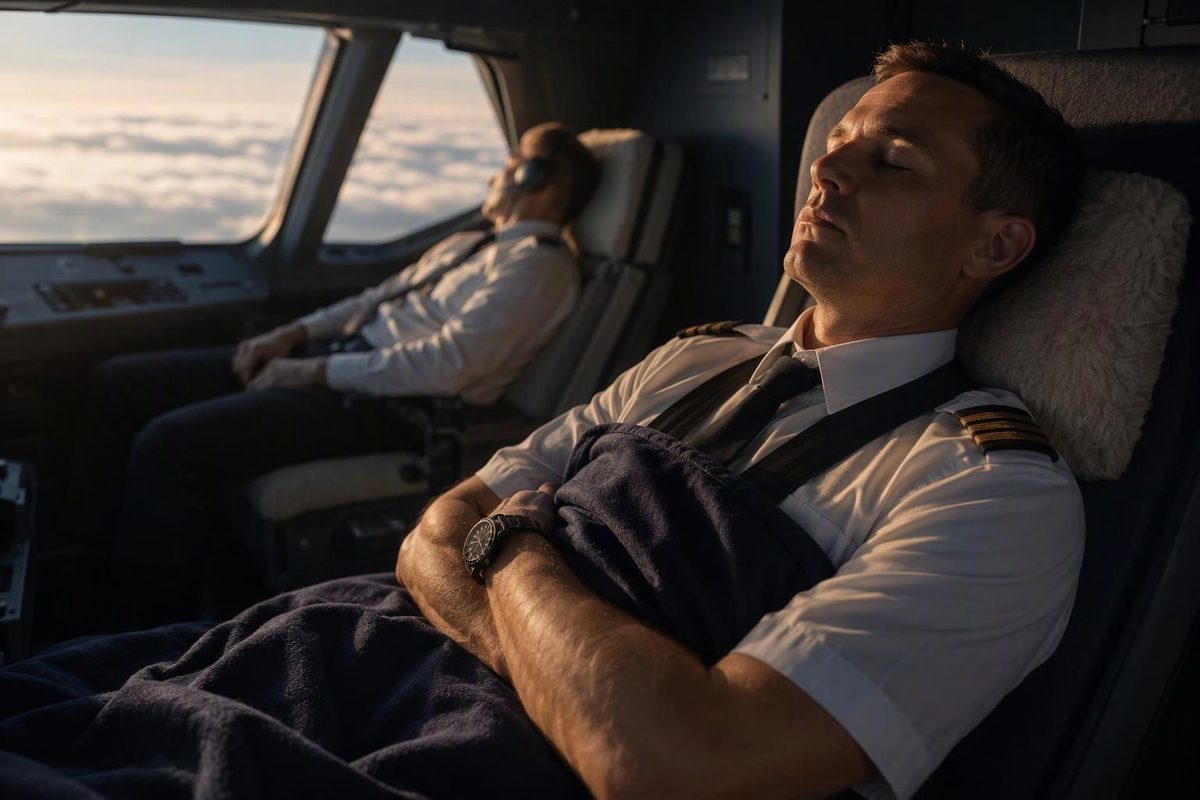
Yes—but only under defined procedures, and the rules depend on the regulator, operator and crew arrangement. On a long flight with extra pilots, an off-duty pilot may sleep in an approved bunk or rest seat. Some regulators also permit one of the two operating pilots to take a short, controlled nap in the cockpit during cruise. Published FAA guidance for U.S. Part 121 airlines permits the first arrangement but not the second.
An approved procedure does not leave the aircraft without an awake, qualified pilot responsible for the controls.
Two kinds of pilot sleep are easily confused
Planned rest with an augmented crew
Long flights may carry three or four pilots rather than the minimum two. Pilots rotate out of active duty and may sleep in a crew bunk or designated seat, often for hours rather than minutes.
U.S. regulations define an augmented flightcrew as one with more than the minimum number of pilots, allowing one pilot to be replaced by another qualified pilot for in-flight rest. They require at least one qualified pilot at the flight controls at all times. They also require protected in-flight rest opportunities for the pilots who will fly or monitor during landing (14 CFR 117.3; 14 CFR 117.17).
The FAA recognizes three classes of onboard rest facility:
- Class 1: a separate, flat sleeping surface isolated from the flight deck and passenger cabin.
- Class 2: a flat or nearly flat seat in the cabin, separated from passengers by at least a curtain.
- Class 3: a seat in the cabin or flight deck that reclines at least 40 degrees and provides leg and foot support.
Before conducting augmented-crew operations, a U.S. airline must have its onboard rest facility qualified and obtain the relevant operational authorization (FAA Advisory Circular 117-1).
This is scheduled crew rotation—not a captain unexpectedly deciding to sleep.
Controlled rest in the cockpit
Controlled rest is a brief, in-seat sleep opportunity for a pilot experiencing unexpected fatigue. It is used during a low-workload part of cruise. One pilot rests temporarily while the other remains responsible for the aircraft.
Under EASA rules, the commander may organize controlled rest if workload permits. The procedure must be described in the operator’s operations manual. It cannot count as a legal rest period or be used to justify extending the duty day (EASA FAQ 47640). EASA’s operations-manual guidance also calls for procedures covering controlled rest in the flight crew compartment (EASA Part-ORO guidance).
EASA does not set one universal promise that every cockpit nap will last exactly 20, 30 or 45 minutes. The operator’s documented procedure supplies the timing and safeguards.
For U.S. commercial airlines, published FAA guidance draws a different line. As quoted by the Flight Safety Foundation, the FAA authorizes in-flight sleep when an augmented crew allows two pilots to remain on the flight deck, but it does not authorize an operating pilot’s in-seat cockpit nap (Flight Safety Foundation).
What a controlled-rest procedure looks like
Exact checklists vary, but controlled rest is built around safeguards such as these:
- It occurs during a low-workload phase of cruise, not during takeoff, approach or landing.
- Only one operating pilot rests at a time.
- The pilots brief relevant matters such as fuel, route, planned duties and the wake time beforehand.
- The resting pilot is awakened at a preset time.
- A recovery period follows before that pilot resumes operational duties.
- Use is reported or monitored so repeated reliance on controlled rest can reveal a scheduling or fatigue problem.
The Flight Safety Foundation guide gives an example with 40 minutes for controlled rest followed by at least 20 minutes of recovery. That recovery window matters because waking can temporarily produce sleep inertia—grogginess, disorientation and impaired thinking. It is a safety buffer, not wasted time. See how nap depth and duration affect sleep inertia symptoms.
The stated duration is a rest opportunity, not necessarily that many minutes asleep. A pilot needs time to settle, may not fall asleep immediately and must wake before the recovery period begins.
Why allow a pilot to sleep at all?
Fatigue does not disappear because the work is safety-critical. Night flying, long duty periods, time-zone changes and prior sleep loss can reduce vigilance. Controlled rest aims to improve alertness before demanding phases such as descent and landing rather than letting unexpected sleepiness progress unmanaged.
In a NASA field study published in 1994, 12 pilots received a 40-minute cockpit-rest opportunity during long-haul cruise while nine pilots continued normal duties. Resting pilots slept during 93% of the opportunities, took an average of 5.6 minutes to fall asleep and slept for 25.8 minutes. Their subsequent objective alertness and vigilance were better than those of the no-rest group, with benefits continuing through descent and landing (NASA technical report).
The study was useful but narrow: it involved only 21 pilots, one transpacific trip pattern and three-person Boeing 747 crews. Two crewmembers continued operating while one rested, so it did not directly test today’s two-pilot controlled-rest arrangement.
A 2024 observational study provides more current evidence from two-pilot operations. Researchers analyzed 120 flights longer than 6.5 hours involving 31 pilots at a European airline. After adjustment for pre-flight performance, prior sleep and flight timing, pilots who took controlled rest had faster responses on a vigilance test at top of descent. The groups did not differ significantly in self-rated sleepiness or vigilance lapses. Because pilots chose whether to rest rather than being randomly assigned, the result supports an association rather than proving that every cockpit nap improves performance (Frontiers in Environmental Health).
A short nap is therefore a fatigue countermeasure, not a substitute for adequate off-duty sleep. EASA says frequent use can indicate that scheduling safeguards are not preventing excessive wakefulness. Longer planned sleep belongs in augmented-crew operations; controlled cockpit rest is a limited safety net.
What this means for passengers
Seeing a pilot head toward a crew-rest area on a long flight can be normal: extra pilots are rotating so those needed later can rest. On some non-U.S. airlines, one pilot may instead take a short nap in the cockpit under the operator’s controlled-rest procedure while the other remains awake and responsible for the aircraft.
Both operating pilots deliberately sleeping, an unbriefed nap or sleep during a high-workload phase is not controlled rest.