
When the Boost Fades—and Why the Caffeine May Not
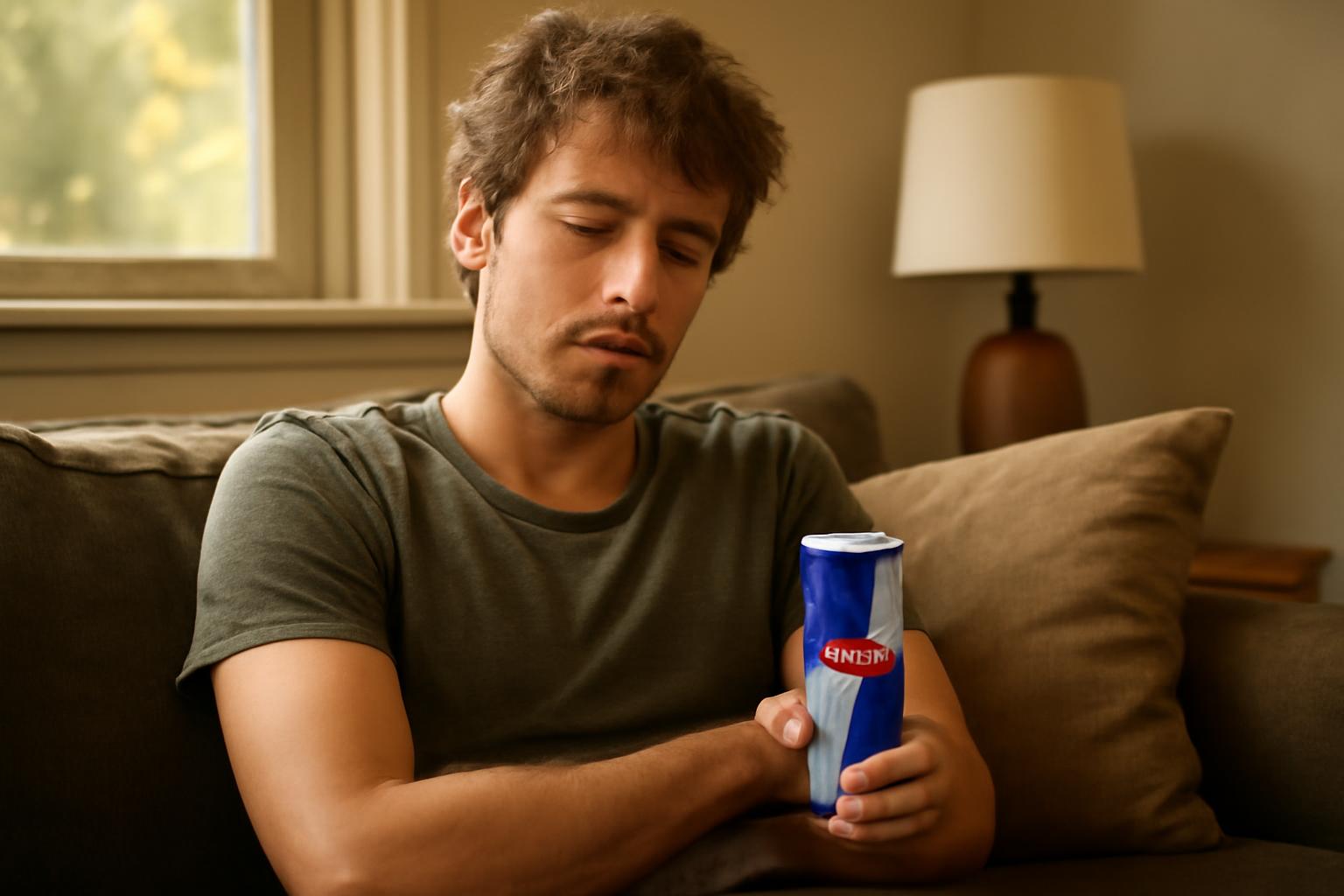
The short answer: roughly 1–4 hours, but not for everyone
This is not an official Red Bull estimate or the result of a controlled trial establishing how long the drink works in every person. It comes from a commercial coffee-company overview.
A separate, uncited commercial sleep-clinic article says energy drinks including Red Bull may support alertness for about 4–6 hours. It does not tie that estimate to a particular can size or study, so the broader alertness range should not be treated as a Red Bull-specific guarantee.
One possible explanation for the difference is that “energy” and “alertness” do not necessarily describe the same experience. The obvious lift may fade while weaker stimulation remains. Neither source demonstrates that this distinction accounts for the conflicting ranges, however, so it is an interpretation rather than an established finding.
Red Bull’s product information confirms ingredients and serving details but gives no onset or effect-duration estimate. This article therefore offers an uncertain synthesis, not a precise countdown.
The scope is one original 8.4 fl oz can. Do not automatically apply the estimate to larger cans, multiple servings, sugar-free products or other Red Bull varieties. Most importantly, feeling the boost disappear does not mean that the caffeine has left your body.
What is in the 8.4 fl oz original can?
One original 8.4 fl oz Red Bull contains 80 mg of caffeine and 27 g of sugars. Red Bull also lists taurine, B-group vitamins and water. The manufacturer says caffeine helps improve concentration and increase alertness, but it does not say how long those effects last. Its page lists 8.4, 12, 16 and 20 fl oz cans, while the cited caffeine and sugar figures apply specifically to the 8.4 fl oz product described on the official Red Bull product page.
Caffeine is the most useful listed ingredient for discussing the timing of stimulation. The available evidence does not establish that taurine, B-group vitamins, sugar or the complete formula adds a particular number of hours to the drink’s effects.
Duration also should not be scaled mechanically from can size. More caffeine could alter the experience, but the evidence does not provide a formula in which a larger can produces a predictable number of additional hours.
Check the label on the exact product in your hand. Confirm its size, formulation, caffeine amount and serving information instead of assuming that every Red Bull has the same contents as the original 8.4 fl oz can.
A cautious Red Bull effects timeline
This timeline is a low-confidence summary of generic energy-drink material and two weak commercial estimates. It is not based on a controlled trial that followed adults after one 8.4 fl oz Red Bull.
The approximately 10-minute entry, 15–45-minute peak, one-hour decline, 5–6-hour half-life and 12-hour clearance markers all come from a single hospital-hosted but uncited energy-drink infographic. They should be read as rough secondary-source markers, not precise biological deadlines.
| Time after drinking | Cautious interpretation |
|---|---|
| Around 10 minutes | Caffeine may begin entering the bloodstream. This does not guarantee a noticeable effect at that moment. |
| Around 15–45 minutes | The generic infographic places peak blood caffeine or alertness in this early window. A subjective peak may not occur at the same time. |
| Around 1 hour | The obvious lift may begin fading, but a crash is not inevitable. |
| Around 1–4 hours | Rough window for the most noticeable boost in the commercial Red Bull overview. |
| Up to roughly 4–6 hours | Loose alertness estimate from the commercial sleep-clinic article. |
| Around 5–6 hours | Secondary material treats this as a typical caffeine half-life estimate, not an effect-duration promise. |
| Around 12 hours | The generic infographic says most people may have removed caffeine from the bloodstream by around this point, but it is not a universal clearance deadline. |
These markers describe different processes. Caffeine beginning to enter the bloodstream is not the same as noticing an effect. Peak blood concentration is not necessarily the same as peak subjective energy. The end of the obvious boost is not the same as caffeine elimination.
For example, after a 2 p.m. drink, someone might feel the clearest lift during the afternoon and notice it fading well before bedtime. Caffeine could still remain relevant later that evening. That is an illustration of how the timelines can diverge, not a prediction for an individual reader.
Feeling normal is not the same as clearing the caffeine
Four concepts should be kept separate:
- Onset: when caffeine begins entering circulation or when you first notice a change.
- Peak alertness: when stimulation feels strongest or blood caffeine approaches an early peak.
- Noticeable duration: how long you subjectively feel more energetic or alert.
- Caffeine elimination: how the amount of caffeine in the body decreases over time.
A half-life is the period over which the amount of a substance is reduced by approximately half. The secondary infographic estimates a caffeine half-life of about 5–6 hours; it does not establish that this applies uniformly to every consumer. It also says that full removal may take around 12 hours for most people, while acknowledging variation by factors such as age and activity (Cincinnati Children’s-hosted infographic).
Using the reference can only as a mathematical illustration, half of 80 mg is 40 mg. If a person followed the stated half-life model exactly, about 40 mg would remain after one half-life. This is not a blood test or personalized prediction; actual absorption and elimination may differ from the simplified model.
Subjective energy can also weaken before caffeine has been cleared. Conversely, caffeine can remain in the body without producing an obvious sense of energy.
A return of tiredness therefore does not prove that caffeine is gone. Continued caffeine presence also does not guarantee that a person will still feel alert.
Why the duration varies from person to person
Caffeine tolerance
Regular caffeine exposure can make the same dose feel weaker. The generic infographic says tolerance may develop over 7–12 days of regular exposure, but its timing is uncited and should not be treated as a universal biological rule.
A weaker effect does not prove faster elimination. Tolerance concerns how strongly a dose is perceived; clearance concerns how the body reduces the amount of caffeine present.
Sensitivity and metabolism
People can differ in caffeine sensitivity and processing, so the same can may feel strong to one person and modest to another. The supplied secondary sources also name age and medications as possible contributors.
The Cincinnati Children’s-hosted infographic specifically says oral contraceptives may slow the reduction of bloodstream caffeine. That is a secondary-source statement, not a dosing rule or a prediction for a particular person. Do not change medication or caffeine use on that basis without individualized professional advice.
Current sleep status
Sleep status can shape how the drink feels.
An energy drink does not establish why a person is sleepy. Persistent excessive daytime sleepiness, repeated insomnia or an ongoing need for stimulants deserves attention beyond adjusting the timing of another can.
Food, activity, hydration and body mass
It does not provide reliable rules for how many minutes or hours any one factor adds or removes.
These variables should therefore be treated as possible context, not inputs for a personalized duration calculator.
When variability needs individualized guidance
Medication questions, unusual caffeine sensitivity, a known sleep disorder or persistent excessive daytime sleepiness cannot be resolved by an average Red Bull timeline. A pharmacist or qualified healthcare provider can consider the specific medication, symptoms and health circumstances involved.
How long can Red Bull remain relevant to sleep?
Red Bull may remain relevant to sleep after the obvious boost has faded. The secondary 5–6-hour half-life estimate helps explain why, but it cannot be converted into one bedtime cutoff that is harmless for everyone.
Someone may feel normal by evening and still sleep differently that night. Another person may drink the same product at a similar time without noticing a problem. Differences in sensitivity, tolerance, metabolism, sleep schedule and total caffeine exposure prevent a universal prediction.
Observational research provides a broader reason for caution but does not answer what one can will do on one night. A Norwegian study reported in USA Today included more than 53,200 college and university students aged 18–35. More frequent energy-drink use was associated with shorter sleep, insomnia and other sleep problems, and daily consumers reported about 30 minutes less sleep per night than occasional or non-consumers (USA Today’s study report).
Those findings have important limits:
- Consumption and sleep were self-reported.
- The research concerned energy drinks generally, not Red Bull alone.
- It examined consumption patterns rather than one 8.4 fl oz can.
- Observational findings cannot establish that energy drinks caused the reported sleep problems.
- Reverse causation is possible: people who already sleep poorly may consume more energy drinks.
The practical takeaway is limited but useful: the apparent boost can end before the caffeine is necessarily gone. If Red Bull repeatedly coincides with difficulty sleeping, reconsider the timing and discuss persistent sleep problems with a qualified healthcare provider.
The crash question: caffeine, sugar, or underlying tiredness?
A post-Red Bull crash is possible, but it is not inevitable and has not been established as one single mechanism. Generic energy-drink material places the beginning of lower energy at around one hour and attributes it to fading caffeine effects combined with a possible sugar-related decline.
The evidence does not prove that sugar alone causes every reported crash. Other possible interpretations include:
- waning subjective stimulation;
- caffeine tolerance;
- pre-existing sleep debt;
- a change in normal daily alertness; or
- expectations about how dramatic or long-lasting the boost should feel.
These are possibilities, not diagnoses.
Original 8.4 fl oz Red Bull contains 27 g of sugars, according to the manufacturer’s product information cited above. Sugar-free formulations remove the sugar component, but the supplied evidence does not establish that they prevent fatigue, eliminate a perceived crash or last exactly as long as the original drink.
The exact product label matters. Confirm the caffeine amount and formulation before comparing original and sugar-free products. The available sources do not support a reliable duration comparison between them.
NapHelp also lists Why Do Energy Drinks Make Me Sleepy? as general reading about sleep debt, tolerance, timing, serving size and sugar. Its listing does not establish a Red Bull-specific crash mechanism.
How to interpret the estimate safely
Treat the rough duration estimate as a planning range—not as a countdown clock, caffeine-clearance test or assurance of safety.
A practical approach is to:
- Identify the product. Check the can size, formulation and labeled caffeine amount.
- Record the timing. Note when you started and finished the drink.
- Count overlapping caffeine. Total disclosed label amounts from other caffeinated products only to understand exposure, not to infer a personalized safe dose.
- Note the perceived peak. Record when the effect first becomes noticeable and when it feels strongest.
- Record the return of fatigue. Do not assume that this marks complete caffeine clearance.
- Consider sleep that night. Note whether winding down or sleeping as expected becomes more difficult.
- Look for repeated patterns. One experience cannot determine your metabolism or diagnose a sleep problem.
Tracking provides observational information, not a medical measurement. It cannot reveal blood caffeine levels, determine a safe personal dose, diagnose tolerance or rule out a sleep disorder.
Be cautious about consuming another can simply because the first no longer feels effective. The initial caffeine may still be present, and another serving increases total exposure rather than resetting the first dose’s timeline.
Do not use Red Bull as a routine substitute for adequate sleep or as a way to manage unexplained daytime sleepiness. NapHelp provides general information, not individualized medical advice, and cannot determine a reader’s metabolism, medication interactions, sleep-disorder status or safe personal dose. Its informational-content terms advise readers with sleep disorders, excessive daytime sleepiness or health concerns to consult a qualified healthcare provider.
The practical hierarchy is straightforward:
- Expect the obvious boost to end before caffeine is necessarily gone.
- Assume substantial person-to-person variation.
- Check the exact product rather than generalizing from one can.
- Do not interpret renewed tiredness as proof of caffeine clearance.
- Give persistent sleepiness or sleep disruption priority over attempts to optimize stimulant timing.
Frequently asked questions
How soon does Red Bull start working?
A generic energy-drink infographic says caffeine may begin entering the bloodstream at around 10 minutes and places peak blood caffeine or alertness at approximately 15–45 minutes. These are rough secondary-source markers, not exact Red Bull-specific timings.
A person may notice a gradual effect, a later effect or no distinct change. Subjective alertness also may not peak at the same time as blood caffeine.
Does Red Bull stay in your system for 12 hours?
It can remain relevant for many hours, but 12 hours is not a universal clearance deadline. The Cincinnati Children’s-hosted infographic describes about 5–6 hours as a typical half-life estimate and says most people may remove caffeine by around 12 hours, while acknowledging individual variation.
A half-life means that the amount may be reduced by approximately half—not eliminated. Feeling normal sooner does not establish that no caffeine remains.
Does sugar-free Red Bull last as long as original Red Bull?
The supplied evidence cannot establish that they last the same amount of time. Check the caffeine amount and formulation on each product rather than applying the original 8.4 fl oz can’s figures automatically.
Sugar-free Red Bull also does not guarantee that fatigue, a perceived crash or sleep disruption will be avoided.
Why does Red Bull feel weaker if I drink caffeine regularly?
Regular caffeine exposure can produce tolerance, making a familiar dose feel less noticeable or shorter-lived. The commercial duration overview and generic energy-drink infographic both describe reduced perceived effects with regular use.
That does not necessarily mean caffeine is being eliminated faster. Perceived strength and caffeine clearance are separate questions.
Can Red Bull disrupt sleep after the energy boost wears off?
Potentially. The noticeable lift may fade before caffeine has been eliminated, so feeling tired or normal again does not prove that sleep can no longer be affected.
There is no fixed pre-bed cutoff that guarantees Red Bull will be irrelevant to every person’s sleep. If it repeatedly coincides with insomnia—or if excessive daytime sleepiness repeatedly drives energy-drink use—seek individualized guidance rather than relying on another can.